Pages

Showing posts with label Budget. Show all posts

Monday, December 26, 2011

GOP Issues Part Two: Taxes

Article first published as GOP Issues Part Two: Taxes
 
 on Blogcritics.


In another social and governmental area with arguments as old as politics, taxes will continue to be an issue; paraphrasing Benjamin Franklin, the only thing other than death which is a certainty.  This is of special interest now because of the recent Congressional decision on the payroll tax cut.  Wikipedia has an interesting pseudo-definition for taxes, “A nation’s tax system is often a reflection of its communal values and/or the values of those in power…making choices regarding the distribution of the tax burden; who will pay taxes, how much they will pay, and how the taxes collected will be spent.”  Certainly there is some disagreement between the two parties (and all Americans) on how tax revenue should be spent (but that is not the topic under discussion).  For further edification on a related topic, here is an article with the gist of how the Republicans and Democrats see tax cuts.

Since 1789 there have been various times when the U.S. government either collected taxes, or didn’t.  One notable period lasting 44 years, from 1817 to 1861, was completely without internal revenue by taxation; instead, the government relied on customs duties and land sales (see below for how this is similar to Ron Paul’s tax plan).  See History of the U.S. Tax System more information.  During the Civil War congress passed the Revenue Act of 1861, which first levied taxes on personal income at 3%.  1862 saw the introduction of tax brackets: 3% up to $10,000; and 5% for higher incomes.  In 1872, income tax was abolished and then again reinstated in 1894, during which time revenue was mostly from excise taxes on liquor and tobacco.  By 1909 Congress had what they considered a workable plan, but it languished until 1913 when finally ratified.  Here is a site that has both the signed resolution for the 16th amendment and the original tax form.  

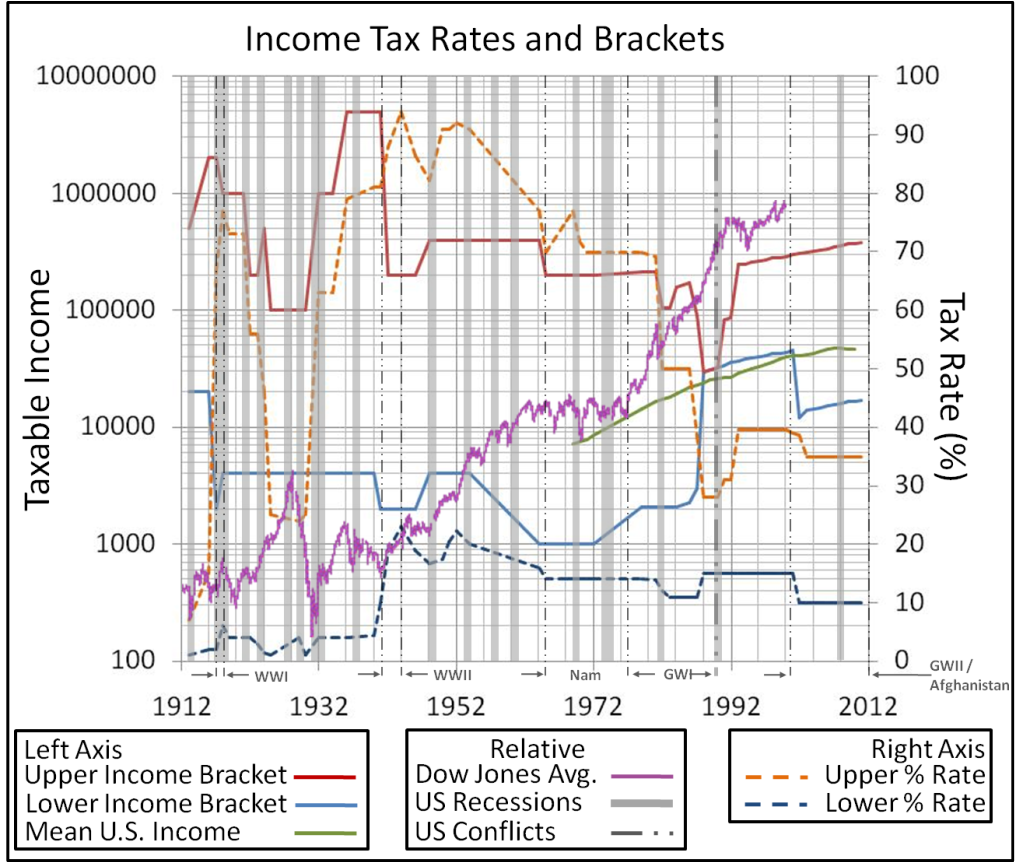
Moving into what I would consider the modern age of government and taxes, starting in 1913 forward to present, this chart shows the upper and lower brackets (left axis), the rate for the brackets (right axis), and for 1969 to present, the mean income (left axis).  Just because it didn't seem complicated enough, I overlaid the DJIA for the period, the recessions of note, and major military actions (time axis only).  There are some interesting possible correlations, but those may only exist in my mind; draw your own conclusions.  Click here for a larger view.


As taxes have evolved throughout the years, from zero early on to a maximum of 94% (for income over $200,000 during World War II), both the rates and the thresholds have changed very frequently.  The current U.S. rates are 15% for the lower bracket and 35% for the upper, which seem reasonable compared to other countries.  In looking at the countries with the ten highest Gross Domestic Products, only Brazil, India, and Canada have higher upper bracket taxes (see chart).  For the lower bracket, which is likely more important since more people are in that bracket and therefore more taxes are collected, only Italy has a higher rate.  Further down the list is Belgium, 21st in GDP according to Wiki and 18th as judged by the IMF, but with a marginal tax rate of 54%; now the U.S. starts to look even better.  In fact, this site indicates that America has the second lowest marginal tax rate.

So it would seem that all-in-all the U.S. fares better than many first-world countries when it comes to taxes.  As much as we would like to complain about this topic, things could be much worse.  Given all of the above, what do the GOP candidates have in store for the future of taxes?

Michele Bachmann believes that taxes are too high (which she should know about, being a tax attorney), people have less to spend on priorities, and that having taxpayers keep more of their earnings would strengthen the economy and stimulate job growth.  She has sponsored several bills in Congress to relieve the tax burden, unfortunately none of them passed.  With typical Republican histrionics, Michele has claimed that “not one shred of evidence that lowering the payroll tax rate created jobs” exists, although BLS data shows more than 1.4 million jobs were created or restored during the 11 months since the tax holiday began.  One of her ideas, for cutting capital gains rates, would seem to add to the deficit rather than help reduce it, but maybe she has other ideas for deficit reduction.  This article is a little inflammatory, but has an intriguing slant, saying that Bachmann’s advice for Americans to flaunt the law borders on treason.  Maybe the most telling words come from fellow party member and Minnesotan, Tim Pawlenty, saying “"Her record of accomplishment in Congress is non-existent.”

“Food stamp president” is what twenty-year political veteran Newt Gingrich called Obama in this article saying, “We’re at the crossroads…down one road is a centralized bureaucratic socialist welfare system…  Down the other road is a proud, solid, reaffirmation of American exceptionalism.”  He too favors the elimination of capital gains tax, and reducing corporate and death taxes; accelerating economic growth by encouraging investment.  His plan is said to be too aggressive and could lead to huge deficits by giving the richest Americans gigantic tax breaks; reducing government revenue by $1.3 trillion in 2015.  Gingrich has plans to keep taxes low, essentially by keeping the “Bush-era” tax cuts, and instituting a flat 15% rate.  Some suggest that a flat tax would cause the loss of more than 800,000 jobs almost immediately, as explained here.

Is the fact that Jon Huntsman served as Obama’s ambassador to China the only reason Republicans won’t support him, or is it because he is a rich, moderate?  He says it’s because, “I don’t sign those silly pledges.  I don’t pander.  I won’t do Don Trump’s silly debate.”  Along with the now common flat tax (although in three rate brackets) and eliminating capital gains tax, Huntsman wants a tax form that, “resembles a postcard”, and to get rid of “all deductions and loopholes.”  He claims that since this worked Utah it can work nation-wide; assuming that this can scale upwards, of course.  Earlier this year he acknowledged that this would constitute a tax increase, saying that he would, “…invest that back into the tax code.”  Here he has a few more words on his tax plan and the economy in general.

Ron Paul goes beyond the Republican pale, planning the complete elimination of income tax and the IRS saying that, “…55%, over half of all revenue, comes from other sources like excise taxes, fees, and corporate taxes…We could eliminate income tax… and still fund the same level of government we had in the late 1990s.”; according to PolitiFact, this is mostly true – a difference of only $150 billion.  He calls income tax “a form of involuntary servitude, which was supposed to have been outlawed by the 13th amendment.”  There is some possible flip-flopping with Paul’s tax plan (called “paulonomics” by some), as shown in this article, which also highlights some of his stances on other issues.

Fox News calls Rick Perry’s tax plan “fiscally irresponsible” and unable to jump start the economy.  According to Fox, the plan calls for taxpayers to choose between a 20% flat tax, and staying with the current system; it seems highly unlikely that most would choose the flat tax.  By his own words, printed in the Wall Street Journal, he says, “The mind-boggling complexity of the current tax code helps large corporations with lawyers and accountants devise the best tax-avoidance strategies money can buy.”, but it seems that little would change in that regard, either.  Perry’s plan also calls for increasing both personal and dependent exemptions, up to $12,500 each, which would seem to lower tax revenue, but according to him, would stimulate economic growth.  This site explains why the tax won’t be as flat as Rick makes it out to be.

Mitt Romney is in favor of tax cuts similar to the ones enacted in 2002 by Bush, claiming that he supported them at the time, and pledges to roll back taxes to 5% by the end of 2012.  In this article he explains how his vision of a “merit-based opportunity society”, compares to Obama’s “European social democracy”, by reducing corporate tax rates and eliminating capital gains, which seems to be very popular among the candidates.  It may be that Mitt feels that his business acumen will give him insight into the workings of the tax codes, which he certainly used to his advantage while working at Bain.  Here are some statements Romney made on taxes and the economy.

Another proponent of lowering taxes, Rick Santorum claims to have always voted in favor of lowering taxes, removing the death tax, and cutting corporate rates.  Know as the “Made in America” plan, it focuses primarily on the manufacturing sector by, in one instance, repatriating off-shore companies and zeroing their tax rate.  Rick plans on making U.S. businesses more competitive by cutting corporate tax rates in half, down to 17.5%.  His personal tax rates, just two brackets, would be 10% and 28%, which is a return to Reagan era rates.

Disregarding corporate taxes, not that they aren’t important to the economy, and also economic stimulus which is equally important, the next most critical aspect of any tax changes, to most Americans, will be the personal income tax rates.  Here is why I think the inequality of income, and of taxes, makes more of a difference than most Republicans give it credit for. 

Let’s look at two groups of American families, one close to average and the other high, upper-middle class.  The average group (Group A) makes between $40,000 and $60,000, and consists of approximately 20,000 families; we will say that their income is $50,000.  The upper group of about 17,000 (Group B) has a lower income level of $100,000 and a top level of $250,000; we will call their income $150,000, on average, for the group.  Using census data, this chart compares expenses for the two groups, with Group B spending 20% more on each expense type (probably not accurate, but I don’t make $150,000, so I’m just guessing).  Now, let’s take, for example, the cost of a home for $150,000; according to this site, it should be a little higher, but this is a good round number.  Group B has, according to the census data and my calculations, almost 5 times the money to spend towards housing, $120,000 per year, while Group A only has $25,000 to spend.  It is clearly much easier for Group B to afford a down payment and mortgage, than for Group A.  This concept extends to any expense that is not considered a need by the census bureau; savings, education, leisure activities like vacations, or emergencies.  While the basic necessity costs are very similar regardless of your income, the amount available for luxuries or niceties is drastically different.

This analysis does not take into account the very rich or the marginally poor, where the differences are even more extreme.  I do not advocate for a socialist system; no sharing of the wealth or redistribution.  One of the few things that can be controlled, to help the lower classes to be able to live just slightly more comfortably, is the amount of tax burden.  Keep this in mind while evaluating each candidate’s plan.

I believe that the first and most important goal of the future president should be reducing waste, fraud, and abuse in all government agencies, followed by examining the efficiency of each federal agency.  Given that the government needs revenue to operate, and if we have learned anything over the years about our government, it is that they rarely cut spending, we will need taxes.  If we believe that the examples we see from other first-world countries are remotely accurate, then U.S. taxes are near reasonable levels.  Assuming that reductions, savings, and gains in efficiency can be made, then we will be better prepared to look at lowering the tax rates.


Monday, November 21, 2011

Can we do anything to improve the job and economy situation?


I made some comments in several forums today that got me to thinking about how to get unemployed people back to work.  If we can get the unemployment rate down, I believe that the economy will improve; investors will have more confidence, buyers will spend more, people will be able to buy houses, and the republicans will get richer (really, no matter what happens to the economy, they will get richer).

The main problem I see with unemployment is that as an entitlement program it gives away money, but there is no other gain from it.  By this I mean that the person receiving it does not gain any new tangible knowledge, skills, or abilities.  All of the entitlement programs should be restructured so that the person benefits in some other way than just receiving a pay check.  Additionally, if the country could benefit in some way while disbursing the money, we would all be better off.

In the 1930s FDR started several programs to ease the US out of the great depression, including the Civilian Conservation Corps (CCC) and the Works Progress Administration (WPA later re-designated as Works Projects Admin).  Both of these programs used unemployed, unskilled labor to improve the infrastructure of the country.

The CCC was primarily responsible for the conservation and development of natural resources, which included such things as: bridges, fire towers, and buildings in national forest areas; irrigation, drainage, dams, and other flood control measures; planting trees, collecting seeds, working in nurseries, and related forestry work, building and maintaining camps and picnic areas, clearing areas, developing and maintaining lakes and ponds; and miscellaneous work such as surveying, large scale mosquito control, and emergency relief.  As many as 2.5 million men took advantage of this program over about nine years.  The WPA made use of another roughly 3 million people over some 8 years on basic infrastructure improvements such as roads, bridges, parks, and dams.  Altogether these two programs employed more than 5 million people that would otherwise been on what we would today call welfare.  That 5 M people represented approximately 4.5% of the 1935 US population.  In 2011 the total unemployed number is around 13 million or about 4.4% of the population.  If we ran similar, proportionally sized projects now, we could give jobs to all of the unemployed and satisfy important national needs.

The question becomes: what projects should we tackle? 

One possibility, right out of the 1930s, that would surely help both the newly employed and others, is dam and levee construction and/or maintenance.  All along the Mississippi river and its feeder rivers are miles of damaged or broken levees.  We have seen in the last few years what the failure of these river control measures can mean to those who live in the flood paths.  Homes and farms destroyed, cities ravaged by the water, and lives lost when the levees break.

Another suggestion is repair of the 50+ year old interstate highway system.

A third is fire prevention in the national forests by clearing brush, creating new fire roads, even reforestation of recently burned areas.

I slightly over 20 minutes I have come up with three possible uses for millions of unemployed people.  How many other possibilities are there?

This kind of work would seem to be a much more valuable stimulus both to the individuals and to the country, than just giving people money and saying “keep looking for work”.

I leave you with a few quotes by FDR – a man and president that lived through the worst times that our country has ever seen, and brought us out of it.

--“A nation that destroys its soils destroys itself. Forests are the lungs of our land, purifying the air and giving fresh strength to our people.”

--“The test of our progress is not whether we add more to the abundance of those who have much; it is whether we provide enough for those who have too little.”

--“Happiness is not in the mere possession of money; it lies in the joy of achievement, in the thrill of creative effort.”

--“True individual freedom cannot exist without economic security and independence. People who are hungry and out of a job are the stuff of which dictatorships are made.

--“There is nothing so American as our national parks. The scenery and the wildlife are native. The fundamental idea behind the parks is native. It is, in brief, that the country belongs to the people, that it is in process of making for the enrichment of the lives of all of us. The parks stand as the outward symbol of the great human principle.”

--“To the Congress:

Unhappy events abroad have re-taught us two simple truths about the liberty of a democratic people.

The first truth is that the liberty of a democracy is not safe if the people tolerate the growth of private power to a point where it becomes stronger than their democratic state itself. That, in its essence, is Fascism—ownership of Government by an individual, by a group, or by any other controlling private power.

The second truth is that the liberty of a democracy is not safe if its business system does not provide employment and produce and distribute goods in such a way as to sustain an acceptable standard of living.

Both lessons hit home.

Among us today a concentration of private power without equal in history is growing.

This concentration is seriously impairing the economic effectiveness of private enterprise as a way of providing employment for labor and capital and as a way of assuring a more equitable distribution of income and earnings among the people of the nation as a whole.”

Have I said enough about OWS?


We have already established that protesters, in general, have the right to assemble and make their grievances heard.  But they don’t have the right to disturb others – the first amendment does not cover that.  And they certainly should obey all of the local laws, respect the neighborhoods where they meet, and the rights of the people, businesses, and property.  It’s hard to tell in all of the conflicting stories whether the protesters are following the rules, or not.  From reading this article, I’m not sure if the man described is innocent or guilty. 
 
In other cities, San Francisco comes to mind, the police are clearly in the wrong.  Embedded in this article is video of officers using pepper spray on a group of students (UC Davis) that are sitting on a curb.  I would love to know what the police were thinking – I mean, we live in a Rodney King world where everyone has the ability to capture video.  At the least it shows stupidity on the part of the officers, and at best…well, I can’t see how there was a best there.  The University of California is not the only school with protesters – OWS organizers say that over 120 colleges and universities have had some sort of affiliated protest.


But, we can feel slightly better given that the police aren’t above arresting one of their own, as shown here.  It’s not all police versus protesters in bloodbaths, nor people living in parks and fighting to use the restrooms of private businesses, there is a little fun going on.  One man thought of a way to project a “bat signal” onto, of all ironic places, the side of the Verizon building in NYC.   To help get into the spirit of Thanksgiving, an unemployed chef is planning a feast for the protesters.
 
We can see that these are real people making up the ranks of the protesters; they have a message and are willing to undergo hardship, deprivation, and even arrest (do beatings and pepper spray count?) to get their message heard – but, who is listening.   This report is about that topic, what comes next?  Millions  of people, all across the US are ready to do something, but I don’t think even they know what that should be.


I don’t see where this can go if it is nothing more than some general grumbling.  If these people can become something more, perhaps a separate political party, THEN things might begin to happen.  Gathering together just to complain as a group doesn’t seem to be working. 
DO SOMETHING!

Saturday, November 19, 2011

What is the Occupy movement all about?


The right to assemble peaceably is guaranteed by the first amendment.  This must have been important to the Founding Fathers since it IS the first of the Bill of Rights, which means that they thought about it, discussed it, perhaps had protests in favor (or not) of it, and decided to include it.  This was first differentiated from the right to petition in 1875 by the Supreme Court as part of “United States v. Cruikshank”, which states, “…the right of the people peaceably to assemble for the purpose of petitioning Congress for a redress of grievances, or for anything else connected with the powers or duties of the National Government, is an attribute of national citizenship, and, as such, under protection of, and guaranteed by, the United States.”

Clearly the OWS movement is within its rights to peaceably assemble, and I would think that they do have grievances worth petitioning the government for.  Read this Wiki article for history and descriptions of earlier protests, and here is the Wiki article specifically about OWS.  Also, take note of my earlier advice about Wiki articles.

Some of the lengths that these protesters go to, to continue their agenda, are quite inventive.  One example is that since the movement does not have a permit to use amplified PA systems, they are using human repeaters to help disseminate the speaker’s words.  After the NYFD removed the gas-powered generators citing a fire hazard, the protesters turned to bicycle-powered ones to provide for their electronic needs.  They also constructed their own greywater system to recycle dishwater for use in the park.  If only Wall Street could find a use for this creativity and innovation (of course only the 1% would likely profit from this).

All that said, I think that they could probably spend their time and effort in better ways.  For instance, if the main complaint is about the wealthy owners of various corporations, how about organizing a boycott of their products and/or services (in the specific case of banks, this should work well).  If the need is for government officials to take their concerns more seriously, have sub-groups maintain a 24/7 picket outside their houses?  That should get their attention.

Here’s another idea: pick out the worst 25 or so perceived offenders and the get retailers and service people to refuse them service.  No more taxi rides, lost reservations, no more best seats in the best restaurants; they wouldn’t be able to buy things in stores or online.  I think that this would send the message that no one can live comfortably without the workers who make business possible.

I dearly hope that this can be resolved peacefully, before more drastic measures are taken by the protesters.  Revolutions have started because of similar grievances before.  Isn’t the Tea Party movement homage to the original namesake?

As I have frequently found, the Founding Fathers had comments that are surprisingly apropos, so I leave you with their thoughts.

"We must not let our rulers load us with perpetual debt. We must make our selection between economy and liberty or profusion and servitude. If we run into such debts as that we must be taxed in our meat in our drink, in our necessities and comforts, in our labors and in our amusements, for our callings and our creeds...our people.. must come to labor sixteen hours in the twenty-four, give earnings of fifteen of these to the government for their debts and daily expenses; and the sixteenth being insufficient to afford us bread, we must live..  We have not time to think, no means of calling the mis-managers to account, but be glad to obtain subsistence by hiring ourselves to rivet their chains on the necks of our fellow suffers.  Our landholders, too...retaining indeed the title and stewardship of estates called theirs, but held really in trust for the treasury, must...be contented with penury, obscurity and exile.. private fortunes are destroyed by public as well as by private extravagance."

"I believe that banking institutions are more dangerous to our liberties than standing armies.  Already they have raised up a moneyed aristocracy that has set the government at defiance. The issuing power should be taken from the banks and restored to the people, to whom it properly belongs."

"If the American people ever allow private banks to control the issue of currency, first by inflation, then by deflation, the banks and corporations that will grow up around them will deprive the people of all property until their children wake up homeless on the continent their fathers conquered."

"... God forbid we should ever be twenty years without such a rebellion. The people cannot be all, and always, well informed. The part which is wrong will be discontented, in proportion to the importance of the facts they misconceive. If they remain quiet under such misconceptions, it is lethargy, the forerunner of death to the public liberty.... And what country can preserve its liberties, if its rulers are not warned from time to time, that this people preserve the spirit of resistance? Let them take arms. The remedy is to set them right as to the facts, pardon and pacify them. What signify a few lives lost in a century or two? The tree of liberty must be refreshed from time to time, with the blood of patriots and tyrants. It is its natural manure."
--- Thomas Jefferson

"Government is instituted for the common good; for the protection, safety, prosperity, and happiness of the people; and not for profit, honor, or private interest of any one man, family, or class of men; therefore, the people alone have an incontestable, unalienable, and indefeasible right to institute government; and to reform, alter, or totally change the same, when their protection, safety, prosperity, and happiness require it."

"Public virtue cannot exist in a nation without private, and public virtue is the only foundation of republics. There must be a positive passion for the public good, the public interest, honour, power and glory, established in the minds of the people, or there can be no republican government, nor any real liberty: and this public passion must be superior to all private passions."

"[D]emocracy will soon degenerate into an anarchy, such an anarchy that every man will do what is right in his own eyes and no man's life or property or reputation or liberty will be secure, and every one of these will soon mould itself into a system of subordination of all the moral virtues and intellectual abilities, all the powers of wealth, beauty, wit and science, to the wanton pleasures, the capricious will, and the execrable cruelty of one or a very few."
--- John Adams

"But the mild voice of reason, pleading the cause of an enlarged and permanent interest, is but too often drowned, before public bodies as well as individuals, by the clamors of an impatient avidity for immediate and immoderate gain."

"If individuals be not influenced by moral principles; it is in vain to look for public virtue; it is, therefore, the duty of legislators to enforce, both by precept and example, the utility, as well as the necessity of a strict adherence to the rules of distributive justice."

"If it be asked what is to restrain the House of Representatives from making legal discriminations in favor of themselves and a particular class of the society? I answer, the genius of the whole system, the nature of just and constitutional laws, and above all the vigilant and manly spirit which actuates the people of America, a spirit which nourishes freedom, and in return is nourished by it."
--- James Madison

And, although not strictly one of the FF, also an important man in early American politics.

"The money powers prey upon the nation in times of peace and conspire against it in times of adversity. It is more despotic than a monarchy, more insolent than autocracy, and more selfish than bureaucracy. It denounces as public enemies, all who question its methods or throw light upon its crimes. I have two great enemies, the Southern Army in front of me and the Bankers in the rear. Of the two, the one at my rear is my greatest foe.. corporations have been enthroned and an era of corruption in high places will follow, and the money powers of the country will endeavor to prolong its reign by working upon the prejudices of the people until the wealth is aggregated in the hands of a few, and the Republic is destroyed."
--- Abraham Lincoln


Thursday, November 17, 2011

What can we do about Social Security?

This will be, for now, my last piece on cutting the federal budget.  I may come back to it if things change, or if there is new news.


The last, large piece of the federal pie, that can reasonably be cut, is Social Security.  It was first enacted by president Roosevelt in 1935 as part of his “new deal”, a series of social programs designed to relieve, reform, and recover the US economy after the great depression.  As part of the Social Security Act, Title II provides for Federal Insurance Contributions Act tax (this is that FICA guy on your pay check).  This Wiki article has a good background on how the program was started and implemented.


The biggest single problem with SSI is that as the country continues to age, the ratio of people depositing money into the program to the number receiving benefits continues to go down.  In the 1940s the ration was 160:1 with more than 35,000 covered workers (putting money in) and only 222 beneficiaries (taking money out).  This has continued to go down until in 2010 the ratio was 2.9:1 (156,000 in – 53,000 out) and it is expected to continue in this direction.


My personal complaint is that the benefit age continues to increase and at this point I won’t be eligible until 3 years after I have died.  Realistically, one of the options for maximizing the fund availability is to continue to increase the minimum benefit age.  The republicans are talking about increasing the age to 70 in the near future, which doesn’t bother them, being the wealthiest party.

There are only two reasonable ways to increase the ratio: increasing payments into the system, although it’s not popular to increase taxes of ANY kind; or continue to increase the eligibility age, not popular either.

Another of the problems I see is the maximum taxable earnings, which is currently capped at $106,800.  Although it is expected to increase to $110,100 in the near future, this still seems like a low number.  It seems reasonable to make this a higher number since there is a large portion of the population that makes substantially more than this amount.  To me, this is another example of people not paying their fair share.  One can argue that these people in the highest earning bracket(s) might not have to rely on SSI to augment their retirement income.  I disagree that this is a fact because even if those people don’t make use of the benefits (but let’s be real, they will expect that too), their descendents may need to make use of them.  The understanding is that current workers are paying for their parents’ generations benefits, which should be true for the upper income brackets as well.  For those in the lower income brackets there will be no change, since you are taxed as a percentage of what you earn.

Now, I have been contributing into a variety of retirement plans for all of my working life, including several IRAs and 401k plans at all of my jobs.  I am in favor of allowing people to take over this last portion of the retirement scheme, but of course, I can’t do that since I’m paying for my mom’s retirement income (wait, my dad has passed on, so can I get credit for him?).  But, over the long term this seems to be a reasonable choice – let people make their own arrangements. 


Another of the significant problems with the SSI system, much like that of the insurance business is fraud – sometime co-located with horrible crimes.
  Here is an example of someone defrauding the SSI system by taking advantage of several disabled people.


Other fraud crimes are about a person’s eligibility – surprisingly, you can’t receive benefits if you are in prison.  Here a man received over $60,000 in benefits while serving time for sexual child abuse.

The fraud does not always involve serious crime, like in the two examples above, but it is still a crime to collect benefits for dead people, as seen in this article.

Of course, in some cases it’s the bureaucracy that makes the mistakes, like in this article about a woman that SSI claims is dead.  She would beg to differ, as I’m sure most of us would.

How can we fix the problems?  There are a lot of suggestions on this but I think the best plans will have individuals making more investments for themselves.  Sock as much as possible into IRAs, since this is a pretax deduction it also helps on your taxes. Wait, I am for everyone paying their fair share (I should just make this an acronym TFS) and this reduces the amount of tax you pay, so that can’t work.  OK, put as much as you can into 401k plans.


As with most government programs, the problem lies more with managing and administering the programs, and less with the stated aims and goals of the program itself.  Much like with the healthcare problems that I wrote about earlier, if we could reduce the waste, remove the fraud, and streamline the processes we could save an enormous amount of the budgeted dollars.

I think that everyone should be as informed as possible about all of the government programs that our dollars are funding.  Here I disagree with Mr. Cain; everyone should read as much as possible.

Tuesday, November 15, 2011

Why does war cost so much?

I thought that it be a simple matter to breakdown the defense budget and easily pick out some spurious costs (OK, not really, there must be 10,000 people poring over those numbers).  Before I get flamed, I want to reiterate that I am pro-military and I served in the US Navy in the ‘80s.  But the defense portion of the federal pie still represents an attractive location for cuts.

We KNOW that we have to make cuts somewhere in the budget, or we will default on our loans.  This is something that most Americans have faced in their own domestic budgets: pay the rent or buy food; pay for the needed medications or pay the car note; buy the children clothes or pay the phone bill.  With times being even tougher now, these decisions are being made more often.  Why can’t the government understand and make similar decisions: cut social programs or defense spending; protect the borders or keep social security; provide for Medicare or…I think that everyone gets the idea.  I know that this is not a simple decision, but when the average American is faced with this they don’t have months or years to come up with an answer.  They don’t have super committees, analysts, aides, or any of the roughly 24,000 member staff that the house of reps has.  And if they saw it coming years ahead of time, wouldn’t they have done something about it before now?  Apparently not.

On to questions about war.  We are currently fighting two major wars: the war on terror, mostly in Iraq and Afghanistan; and the war on drugs, being fought mostly in the US and on its borders.  Just to simplify some of the points that I want to make, I’m going to talk about the War on Terror as just being in Afghanistan.  Some argument can be made that the fighting in Iraq had other reasons than just terrorism.  Now, I believe that had we not taken the war to the terrorists, there would have been more attacks like 9/11, and I also believe that Saddam had to fall, so I’m leaving Iraq out of the discussion.

The War on Terror, in Afghanistan, has lasted longer than Vietnam (10 years in June, 2011), cost to date about $474 billion, there have been just over 1,800 American military deaths (as best I can determine), and an unconfirmed Afghan civilian toll of more than 14,000.  Below are some interesting data and articles about this war.

By contrast, the War on Drugs has lasted 40 years, by my rough estimation has cost the US approximately $435 billion (federal dollars, and more in border state budgets), and the cost in lives is probably uncountable.  Below are some articles and a collection of data about the war on drugs.

I don’t want to reargue the legalization of drugs here; that has been done to death by people that have researched it for years.  There ARE strong arguments FOR legalization, but all I want to say here is that what we are doing is clearly not working.  As Albert Einstein said, “Insanity is doing the same things over and over again and expecting different results.”  Based just on this thought, shouldn’t we at least try something different?


Now it occurs to me that we are fighting one of these wars using the wrong methods.  In Afghanistan we have thousands of boots on the ground, hundreds of Air Force and Navy planes, and most of the Predator and Reaper fleet loitering overhead.  We killed thousands of natives, combatants or not; imprisoned and questioned thousands (not going to touch methods); and spent a trillion dollars.  The War on Drugs has people, planes, boats, helicopters, blimps, a few Reapers of their own, and many less feet on the ground.  But we've never treated the drug fight like the WAR that it is called.  Bring out the heavy artillery, tanks, ships, and do whatever it takes to WIN!

Since we are backing off on the terror war, maybe we should use the troops in the other war.  When we decided that we had to fight the terrorist threat, although no particular nation could be blamed, we still took the fight into other countries.  Why can’t we do the same for the War on Drugs?

We won’t be attacking Mexico – we will be going after narco-terrorists.  Likewise, we are not invading Columbia, just going after the cartels.  Et cetera and so on.  In this war we would have the additional benefit of recovering billions of dollars that could help fund the fighting, and by some estimates of the amount of money in cartel hands, help pay down the deficit.

At the same time we should make every effort to destroy as much of the drug infrastructure as possible, which mostly means destroying crops.  Not with the aerial-sprayed defoliants used in Columbia in the early 2000s, but by the troops on the ground.  We should also treat the growers, refiners, transporters, and sellers of these drugs exactly like we treat the terrorists in Iraq or Afghanistan.  With one possible exception this time, let’s house them in their own country.  We have enough prisoners, both American and foreign, in our prisons.

If we can finish up both of these wars (WW II finish, not Vietnam) then we can begin some rational discussions on how to balance the budget and pay off the deficit.

Sunday, November 13, 2011

Are American corporations too greedy?

I got side-tracked today while reading an article about raising the taxes for the wealthy.  For the record, I am firmly in favor of a flat tax and closing the loopholes that allow people to cheat on their taxes – everyone should pay their fair share.

I haven’t forgotten about the government spending, but I’m hung up on the defense budget.  I’m pro-military and believe that America is what it is in part, because of our strength-in-arms.  But, I also think that there is a lot of fat that can be cut, some horrible inefficiency in implementation, and probably quite a bit of corruption.

America was founded, in part, on the belief that a person could make a living, raise a family, and that the government would help them do this.  Remember, “…life, liberty, and the pursuit of happiness”, or how about “…promote the general welfare, and provide blessings of liberty to ourselves and our posterity”?

One thing to note is that our country, its people, the society as a whole made it possible for companies, corporations, and people to become wealthy.  We live in a place where businesses are not nationalized or their profits stolen by dictators (nor by the IRS), where you are free to start, sell, or run into the ground your very own company.  But, if we allow our economy, our government, or these very businesses to waste this opportunity, then these things will no longer be possible.

[This next paragraph is for the executives, leaders, owners, and shareholders of America’s corporations, so if that’s not you, then scroll down some.]  When you have reductions-in-force or layoffs, so that you can increase profits, most of those people are going to receive unemployment benefits.  That is not money from heaven, it ultimately comes from taxes (I know that both the employer and the employee contribute, but that doesn’t and can’t cover all of it).  This is an inefficient method of saving money since it costs to administer both the unemployment and the taxes.  It is much more efficient to accept lower profits, keep people working, and them paying taxes not spending them.

So are corporations greedy?  I say yes, they are.  It’s not just the profits, or the stupidly huge salaries and bonuses for the executives; they also cheat on their taxes.  For example last year Wal-Mart made ~$22.1 billion in profits and paid out $5.3 billion in taxes – which at ~24% is less than the mandated 35% but there are deductions and credits and so on.  Exxon Mobil made about $30.4 billion and paid $156 million in US federal taxes – which is something like 0.5%.  Now, I understand that there are reasons for this and that it probably follows IRS rules (unless there were some pay-offs), but it is curious.  Here are two articles about corporate profits and taxes.  Check it out and see if it makes sense to you.

So what about the huge bonuses?  We have seen this over and over on the news, where some company that seems to be in trouble and losing money, gives the CEO and/or the top executives a ridiculous bonus.  What gives?

Can you imagine how the conversation went?
[CEO]  So, I managed to make you some indecently large profits this year, even though we lost money and laid people off, and I think I deserve a bonus.
[Board of Directors]  Ok, how about the same amount as your yearly salary?
[CEO]  That’s only like a million dollars.  You do want there to be similar profits next year, right?
[BoD]  Well, yes I do.
[CEO]  Then I think you should up my bonus significantly.
[BoD]  Well, let’s see.  The average worker here got a $650 bonus this year, so how about 20,000 times that much?  That would be…$13.5 million.  Is that doable?
[CEO]  Great, but let’s cut out that worker bonus and we’ll have even higher profits next year.
[BoD]  I like how you think.  Let’s take the corporate jet to Paris for lunch.

Does that sound unrealistic?  Here is an article talking about exactly that.

None of the executives at these corporations built those businesses by themselves; they were built on the backs of the workers.  What could a CEO possibly do that is worth 20,000 times what a worker does: be he a mailroom clerk or an engineer, or a machinist?  He likely didn’t design, manufacture, test, repair, market, sell, or procure material for the widgets.  Did he personally rally the troops and lead the workers to a revolutionary new widget?  Did ANY of them turn down a bonus in order to keep a loyal employee?  Go here for an article about corporate “internalequity”.

It isn’t just the bonuses either, the salaries for top corporate execs are just as crazy.  Here is an article on the top 20 for 2010.

This is starting to sound a bit socialist, and I don’t mean for it to, but clearly I have touched a sore place on myself.  Does any of this make sense to anyone?

A man must always live by his work, and his wages must at least be sufficient to maintain him. They must even upon most occasions be somewhat more, otherwise it would be impossible for him to bring up a family, and the race of such workmen could not last beyond the first generation.

No society can surely be flourishing and happy, of which the greater part of the members are poor and miserable. It is but equity, besides, that they who feed, cloath and lodge the whole body of the people, should have such a share of the produce of their own labour as to be themselves tolerably well fed, cloathed and lodged.
--- Adam Smith, “The Wealth of Nations”

In the opening paragraph I said that everyone should pay their fair share.  If every individual and corporation did, would the deficit be so high?  Would there be more money available for those thin slices of the federal pie, like education and basic scientific research?  Since I have been paying into social security for about 30 years, I would like for there to be something available for me when I need it.

I haven’t been banking $13 million bonuses.

Friday, November 11, 2011

Where does all of the money go?

I had originally planned for my second post to be on the topic of lawyers as politicians.  I had planned for several future posts to be on balancing the federal budget.  In a few blogs that I have recently started following I have seen some posts on budget and spending, which prompted me to change tacks.

As I said in my first post, I am not trying to imply that I have the answers to the questions I ask.  I certainly have suggestions, ideas, or proposals, but my primary interest is in stimulating discussion among the readers.  I would hope that these discussions might eventually come to the attention of someone who can make a difference, or enough someones that changes can be made by our representatives.  On to the question.

I looked up how our tax dollars are distributed because I wanted to be sure of where I pointed my finger.  According to the Center on Budget and Policy Priorities (CBPP) the breakdown is as follows:

Medicare, Medicaid, CHIP            21%        $740B
Defense & Security                         20%        $705B
Social Security                                20%        $705B
Safety net programs                       14%        $493B
Federal benefits                                7%        $246B
Interest on debt                                 6%        $211B
Transportation Infrastructure       3%        $105B
Education                                            3%       $105B
Sci & Med research                           2%         $70B
Other                                                    2%         $70B
Non-security International              1%         $35B


There seems to be a lot here to discuss, so I will just start at the top and work my way down.  I think that there is enough here that I will break it into several posts.  I want to make sure that I have sufficient time for research.

I don’t want to become a pariah by suggesting cuts to Medicare, etc. but it is the largest single expense.  Perhaps cuts are in order but I don’t feel qualified to make that sort of decision (am I even qualified to type this?).  Rather than just cutting this portion of the budget wouldn’t it make more sense to attack medical costs?  Below is a link to an MSNBC article describing what drives health care costs.  In brief they are: Doctors being sued; Administrative costs of insurance; Being female (I’m not touching this); Treatment vs. prevention; More treatment for less care.

Number one on this short list is probably the largest contributor to overall healthcare costs.  I don’t think this is at the behest of the doctors, rather I see it as greed of lawyers (over time you might note my lack of respect for lawyers in general).  Even if patients that have been hurt by medical procedures were to receive exactly what they deserved the costs are jacked up by having to use expensive lawyers and insisting on excessive punitive damages (which drives up number 2, insurance).  If the doctors and hospitals were to be forced to “do the right thing” in regard to patients we would likely see fewer lawsuits.

A second problem I have with these lawsuits is that in no other field do we see the performer of a service being sued even though they gave the best service possible.  Can you imagine suing your plumber for a mistake installing a sink, even if the sink leaked?  What about punitive damages awarded to you for the pain and suffering for not having use of your sink?  If you have an ailment, regardless of if it is treatable using medication or if it requires surgery, you must be willing to accept some level of risk in your cure.  There are no guarantees in life and you certainly don’t have one in regards to your health.  If you have two choices when you go to see a doctor – do nothing and perhaps die or do something and possibly live – what exactly are you out if you try for the cure and then die.  YOU WERE GOING TO DIE ANYWAY, and I would like to add, everyone is, eventually.  Maybe we place too much value on an individual life or maybe we aren’t willing to accept risk.

Number two on the list is the cost of insurance.  I don’t see why this is so complicated to administer, in fact it seems to me that it has been made overly complicated just to justify increasing the cost.  Sure there is a lot of paperwork (what happened to the idea of paperless offices?) but I’m not sure that this tells the whole story.  I think I will pass on this and come back to it in a later post (I don’t like insurance much either).

Number three was being female and I don’t want to address that before I have done more research.

Number four is very interesting and also ties in (in my opinion) with number five.  The idea that doctors aren’t interested in prevention is probably fallacious, but they definitely make more money over the long term on treatment.  The old saw states that “an ounce of prevention is worth a pound of cure” and I think it is as true today as it was whenever it was first uttered. 

We are certainly an overweight country and it costs us in dollars and other ways.  A recent study by George Washington University suggests that obesity costs a person on average $3,762 per year, approximately $1,600 of that in medical or insurance costs ($231 per year for extra gasoline!).  Read the full report here.  Obesity is nearly 100% preventable so why are we wasting so much money on it?  One report by ABC news discussed preventable illnesses and the attendant health costs.  Of the 10 most common chronic illnesses, five of them are, or could be, linked to obesity: Type 2 diabetes, high blood pressure, high cholesterol, heart disease, and strokes (probably tied to hypertension).  I’m not suggesting that all of these ills could be completely cured simply by losing weight, but how could it hurt?

The second part of this issue is that doctors seem to spend more of their time (and thusly more money) performing tests and trying new drugs rather than in actual care of the patient.  Is this because of the fear of lawsuits?  Some of what I have read says that this is at least one of the causes, but the other may also be true.  If a patient is not in obvious need of emergency care, it could be argued that an accurate diagnosis should take precedence over a quick one.  I also suspect that many of the complaints presented are not serious, rather the patient just wants reassurance.  If the doctor can “put them off” for a while, while running tests, they get better on their own.  I am not suggesting that this is the most common case, but I suspect that it happens more than occasionally.

Back to the Medicare…I think that the increasing age of Americans is certainly a factor in the cost of healthcare, but that does not explain why the costs keep rising.  An extra year or two of expenses shouldn’t increase the costs for everyone else, should it?  And I can’t see how this affects my, or your, insurance costs.  And there should be economies of scale that apply as we increase the number of people requesting and receiving some form of care.  And…

Wow, this turned into a rant more about healthcare than about reducing expenses at the federal level.  But, maybe that is where we have to start, at the bottom, and work our way up.  If we can solve some of the smaller problems, maybe the larger ones will be solved by default.

I hope that this will start some discussions whether they are part of this blog’s comments, or you discuss it offline.  Remember, if you want to add to, or correct my logic, point out sites with more or better information, please let me know.