Pages

Showing posts with label Politicians. Show all posts

Saturday, February 11, 2012

Red State or Blue State, Which Would You Rather Live In?

Article first published as Red State or Blue State, Which Would You Rather Live In?
 
 on Blogcritics.

After reading an article a while back, and many of the pointed comments, I wanted to look at the relative differences in a variety of factors, between these United States.  The author of the original article made reference to the supposed difference between the education of the “left” and the “right”, but I don’t think he meant it in terms of schooling.  I think he meant to say, that in his opinion, republicans were more politically astute and questioned why the party that frequently claims to be smarter (the “Intelligencia”) could not see his, or their, viewpoint.

The basis of this article is statistics on a variety of areas from education and income to unemployment and teen pregnancy, and ranking each state in those categories.  But to begin this article, I want to look at which way (politically) each state leans, and then continue with metrics about each.

The current political maps (red, blue, and purple) try and show the direction that each state leans politically, usually based on a current poll, is likely biased by the poll takers own politics, and certainly on the particular questions asked and the manner in which they are asked.  This graphic shows the outcome of the 2008 presidential election, and if you follow this link, the map is interactive and shows the results by state.  There is one of these maps for every national election, but I have never seen one that shows the general, everyday political bent of the states, so I made one.

I determined the “party” of the state by using the following:
·         The party of the state’s Governor
·         The party of the Lt. Governor
·         The parties of the two U.S. Senators
·         The U.S. House of Representatives parties
·         And the parties of the state legislative members

I expect some disagreement over the method used to determine state party affiliation, but of course, you are free to make your own map using whatever criteria you choose.  I think though, that no matter how you split up the states, the conclusions that I came to will still hold.

So my map, as can be seen in this graphic, has some differences from the 2008 presidential map shown in the above link.  My map shows many states as moderate, what the pundits will probably call swing states.  There are also a few that are just plain backwards, both from the 2008 map, and from what I expected.  By using the rating system described above I have also ranked the states from most republican to most democrat-ian.  The six top republican states are: Wyoming, Idaho, Kansas, Utah, South Dakota, and New Hampshire.  On the Democrat side, the six most left are: Hawaii, Rhode Island, Massachusetts, Maryland, West Virginia, and Vermont.  The “moderate” states, centered about the state with the most evenly divided politicians – which is Colorado, are Minnesota, Maine, Oregon, and Kentucky; all five of which count as democrat using my system.  The “swing” states were determined by drawing a line at 60% - 40% for either party; that close to 50% makes them moderate in my book.


To begin with, I have a few statistics about the state populations.  There are 24 democratic states with 154.05M residents, and for republican ones 156.93M in the remaining 26 states.  The highest three democratic states have more people than the top four republican ones, and the republicans have five states with less than 1M citizens while the democratic states have only two that small.  All in all I think that the country is pretty evenly split, as is frequently seen with very close national elections.

The first comparison I made is basic education, using SAT scores as the metric.  I believe that this is a good measure of education, and although comparing college or university grades might be better to judge adult knowledge, there is no good way to determine past or future state citizenship or party affiliation.  Before anyone complains, I considered using the ACT, but it is both less frequently taken, and the SAT in one form or another has been given since 1926.  In the top 15 states, with Iowa being number one – combined average SAT of 1798 – 10 of the states were predominantly Republican, and in the lowest 15 scoring states 8 were republican.  Just to round out this topic, Maine came in last with a combined average score of 1389.


The next category of interest is income, using the median value per household.  New Hampshire seems to be well off with $66,652 per family, while (I don’t think this is a shock) Mississippi comes in last at $36,499.  In the top wealthiest states, eight are predominately republican with their average income being $55,239.  In the lower end, republicans have an average of only $44,838, only six are democrats.


Inextricably, in my opinion, linked to income, is unemployment so that too made my list.  Of the ten states with the highest unemployment, the highest four are democrat; although there is five of each.  At the bottom of the list are four republican states, as is seven of the bottom ten.


I personally feel, as might have been noted in some of my earlier rants, that as a country we are way too fat, so I looked at those stats.  Again, to their shame, Mississippi came in at the bottom of the list with 34.5% of the residents considered obese.  In the bottom 10 states the average rate of obesity was more than 32%, with 7 states being republican.  On the lighter side, the leanest state is Colorado at a little less than 22%, and predominantly democrat with 8 of 10 being democrat.

Another interesting set of statistics was for teen pregnancy rates, and you will never guess which state topped that list; you’re right it’s Ole Miss at 65.7 per 1,000; the lowest on the list was New Hampshire with only 19.8 per 1,000.  In the half with the most pregnancies, 68% are republican, while in the half with the least 64% are democrats.  For completeness sake I should have also reported on abortion rates, but I’m not touching that powder keg.

Which state is the murder capital of the U.S.?  As it turns out, Louisiana top the list at 11.2 per 100,000 people, while the safest (at least in these terms) state is New Hampshire at less than 1 per 100,000.  The worst states for murder had 58% being republican, and in the bottom, safer states it was 52% democrat.  Just in case you had started keeping score, Mississippi came in third for murder.

Using this data, I established the best and worst states to live in.  I ranked every state in each category, and summed all of the rankings; the best having the lowest aggregate scores and the worst with the highest.  Minnesota topped the list along with 8 other democratic states out of the upper 10, and sadly or surprisingly, Mississippi finished last along with 7 other republican states out of the lower 10.  Shown here is a chart of the rankings for each category, by state.

Even though it seems as if republicans are slightly smarter, they don’t seem to be very good with their own money so I surely can’t see trusting them with everyone’s.  It’s also not surprising that given their own lack of health, they can’t seem to come to grips with a national healthcare program.  They, on the whole, have higher rates of teen pregnancy, but seem to kill each other more often, so maybe that’s a push.

Here is the compiled chart, with the ranking for each state.


All in all, it would seem that a person living in a democratically run state is better off, in general, than someone living in a republican state.  That’s certainly a gross generalization, but if you were thinking of moving anyway, it may be something to think about.


Monday, December 26, 2011

GOP Issues Part Two: Taxes

Article first published as GOP Issues Part Two: Taxes
 
 on Blogcritics.


In another social and governmental area with arguments as old as politics, taxes will continue to be an issue; paraphrasing Benjamin Franklin, the only thing other than death which is a certainty.  This is of special interest now because of the recent Congressional decision on the payroll tax cut.  Wikipedia has an interesting pseudo-definition for taxes, “A nation’s tax system is often a reflection of its communal values and/or the values of those in power…making choices regarding the distribution of the tax burden; who will pay taxes, how much they will pay, and how the taxes collected will be spent.”  Certainly there is some disagreement between the two parties (and all Americans) on how tax revenue should be spent (but that is not the topic under discussion).  For further edification on a related topic, here is an article with the gist of how the Republicans and Democrats see tax cuts.

Since 1789 there have been various times when the U.S. government either collected taxes, or didn’t.  One notable period lasting 44 years, from 1817 to 1861, was completely without internal revenue by taxation; instead, the government relied on customs duties and land sales (see below for how this is similar to Ron Paul’s tax plan).  See History of the U.S. Tax System more information.  During the Civil War congress passed the Revenue Act of 1861, which first levied taxes on personal income at 3%.  1862 saw the introduction of tax brackets: 3% up to $10,000; and 5% for higher incomes.  In 1872, income tax was abolished and then again reinstated in 1894, during which time revenue was mostly from excise taxes on liquor and tobacco.  By 1909 Congress had what they considered a workable plan, but it languished until 1913 when finally ratified.  Here is a site that has both the signed resolution for the 16th amendment and the original tax form.  

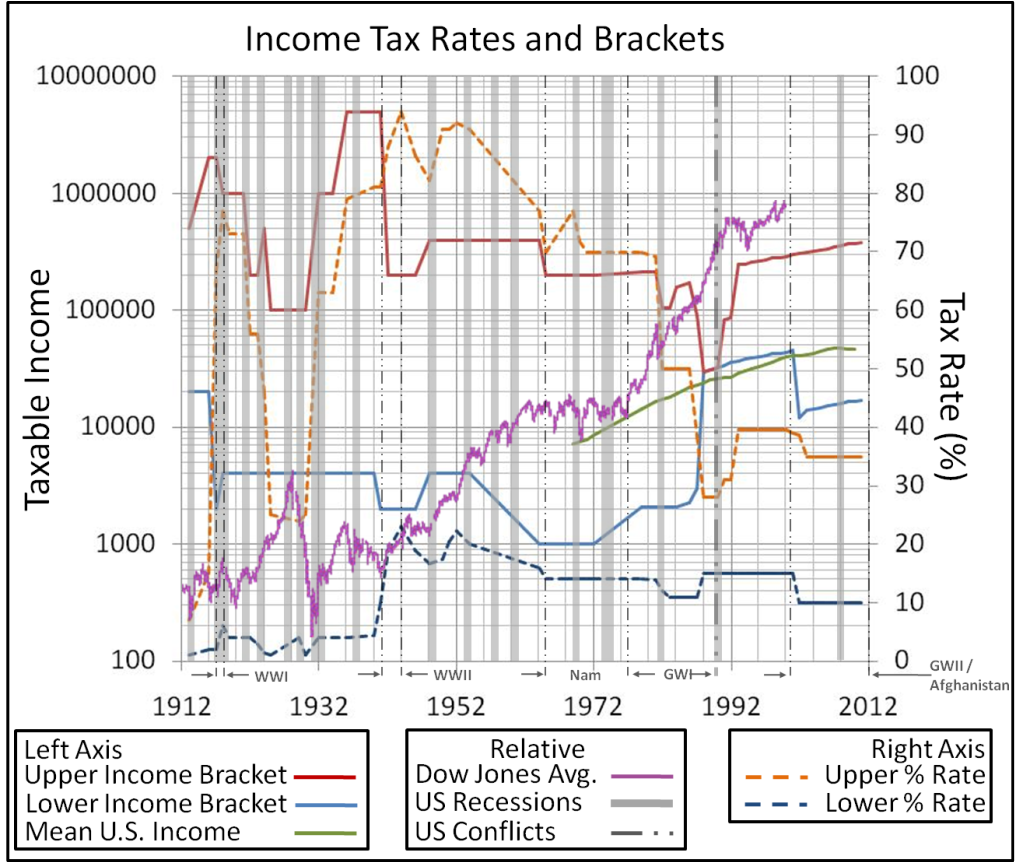
Moving into what I would consider the modern age of government and taxes, starting in 1913 forward to present, this chart shows the upper and lower brackets (left axis), the rate for the brackets (right axis), and for 1969 to present, the mean income (left axis).  Just because it didn't seem complicated enough, I overlaid the DJIA for the period, the recessions of note, and major military actions (time axis only).  There are some interesting possible correlations, but those may only exist in my mind; draw your own conclusions.  Click here for a larger view.


As taxes have evolved throughout the years, from zero early on to a maximum of 94% (for income over $200,000 during World War II), both the rates and the thresholds have changed very frequently.  The current U.S. rates are 15% for the lower bracket and 35% for the upper, which seem reasonable compared to other countries.  In looking at the countries with the ten highest Gross Domestic Products, only Brazil, India, and Canada have higher upper bracket taxes (see chart).  For the lower bracket, which is likely more important since more people are in that bracket and therefore more taxes are collected, only Italy has a higher rate.  Further down the list is Belgium, 21st in GDP according to Wiki and 18th as judged by the IMF, but with a marginal tax rate of 54%; now the U.S. starts to look even better.  In fact, this site indicates that America has the second lowest marginal tax rate.

So it would seem that all-in-all the U.S. fares better than many first-world countries when it comes to taxes.  As much as we would like to complain about this topic, things could be much worse.  Given all of the above, what do the GOP candidates have in store for the future of taxes?

Michele Bachmann believes that taxes are too high (which she should know about, being a tax attorney), people have less to spend on priorities, and that having taxpayers keep more of their earnings would strengthen the economy and stimulate job growth.  She has sponsored several bills in Congress to relieve the tax burden, unfortunately none of them passed.  With typical Republican histrionics, Michele has claimed that “not one shred of evidence that lowering the payroll tax rate created jobs” exists, although BLS data shows more than 1.4 million jobs were created or restored during the 11 months since the tax holiday began.  One of her ideas, for cutting capital gains rates, would seem to add to the deficit rather than help reduce it, but maybe she has other ideas for deficit reduction.  This article is a little inflammatory, but has an intriguing slant, saying that Bachmann’s advice for Americans to flaunt the law borders on treason.  Maybe the most telling words come from fellow party member and Minnesotan, Tim Pawlenty, saying “"Her record of accomplishment in Congress is non-existent.”

“Food stamp president” is what twenty-year political veteran Newt Gingrich called Obama in this article saying, “We’re at the crossroads…down one road is a centralized bureaucratic socialist welfare system…  Down the other road is a proud, solid, reaffirmation of American exceptionalism.”  He too favors the elimination of capital gains tax, and reducing corporate and death taxes; accelerating economic growth by encouraging investment.  His plan is said to be too aggressive and could lead to huge deficits by giving the richest Americans gigantic tax breaks; reducing government revenue by $1.3 trillion in 2015.  Gingrich has plans to keep taxes low, essentially by keeping the “Bush-era” tax cuts, and instituting a flat 15% rate.  Some suggest that a flat tax would cause the loss of more than 800,000 jobs almost immediately, as explained here.

Is the fact that Jon Huntsman served as Obama’s ambassador to China the only reason Republicans won’t support him, or is it because he is a rich, moderate?  He says it’s because, “I don’t sign those silly pledges.  I don’t pander.  I won’t do Don Trump’s silly debate.”  Along with the now common flat tax (although in three rate brackets) and eliminating capital gains tax, Huntsman wants a tax form that, “resembles a postcard”, and to get rid of “all deductions and loopholes.”  He claims that since this worked Utah it can work nation-wide; assuming that this can scale upwards, of course.  Earlier this year he acknowledged that this would constitute a tax increase, saying that he would, “…invest that back into the tax code.”  Here he has a few more words on his tax plan and the economy in general.

Ron Paul goes beyond the Republican pale, planning the complete elimination of income tax and the IRS saying that, “…55%, over half of all revenue, comes from other sources like excise taxes, fees, and corporate taxes…We could eliminate income tax… and still fund the same level of government we had in the late 1990s.”; according to PolitiFact, this is mostly true – a difference of only $150 billion.  He calls income tax “a form of involuntary servitude, which was supposed to have been outlawed by the 13th amendment.”  There is some possible flip-flopping with Paul’s tax plan (called “paulonomics” by some), as shown in this article, which also highlights some of his stances on other issues.

Fox News calls Rick Perry’s tax plan “fiscally irresponsible” and unable to jump start the economy.  According to Fox, the plan calls for taxpayers to choose between a 20% flat tax, and staying with the current system; it seems highly unlikely that most would choose the flat tax.  By his own words, printed in the Wall Street Journal, he says, “The mind-boggling complexity of the current tax code helps large corporations with lawyers and accountants devise the best tax-avoidance strategies money can buy.”, but it seems that little would change in that regard, either.  Perry’s plan also calls for increasing both personal and dependent exemptions, up to $12,500 each, which would seem to lower tax revenue, but according to him, would stimulate economic growth.  This site explains why the tax won’t be as flat as Rick makes it out to be.

Mitt Romney is in favor of tax cuts similar to the ones enacted in 2002 by Bush, claiming that he supported them at the time, and pledges to roll back taxes to 5% by the end of 2012.  In this article he explains how his vision of a “merit-based opportunity society”, compares to Obama’s “European social democracy”, by reducing corporate tax rates and eliminating capital gains, which seems to be very popular among the candidates.  It may be that Mitt feels that his business acumen will give him insight into the workings of the tax codes, which he certainly used to his advantage while working at Bain.  Here are some statements Romney made on taxes and the economy.

Another proponent of lowering taxes, Rick Santorum claims to have always voted in favor of lowering taxes, removing the death tax, and cutting corporate rates.  Know as the “Made in America” plan, it focuses primarily on the manufacturing sector by, in one instance, repatriating off-shore companies and zeroing their tax rate.  Rick plans on making U.S. businesses more competitive by cutting corporate tax rates in half, down to 17.5%.  His personal tax rates, just two brackets, would be 10% and 28%, which is a return to Reagan era rates.

Disregarding corporate taxes, not that they aren’t important to the economy, and also economic stimulus which is equally important, the next most critical aspect of any tax changes, to most Americans, will be the personal income tax rates.  Here is why I think the inequality of income, and of taxes, makes more of a difference than most Republicans give it credit for. 

Let’s look at two groups of American families, one close to average and the other high, upper-middle class.  The average group (Group A) makes between $40,000 and $60,000, and consists of approximately 20,000 families; we will say that their income is $50,000.  The upper group of about 17,000 (Group B) has a lower income level of $100,000 and a top level of $250,000; we will call their income $150,000, on average, for the group.  Using census data, this chart compares expenses for the two groups, with Group B spending 20% more on each expense type (probably not accurate, but I don’t make $150,000, so I’m just guessing).  Now, let’s take, for example, the cost of a home for $150,000; according to this site, it should be a little higher, but this is a good round number.  Group B has, according to the census data and my calculations, almost 5 times the money to spend towards housing, $120,000 per year, while Group A only has $25,000 to spend.  It is clearly much easier for Group B to afford a down payment and mortgage, than for Group A.  This concept extends to any expense that is not considered a need by the census bureau; savings, education, leisure activities like vacations, or emergencies.  While the basic necessity costs are very similar regardless of your income, the amount available for luxuries or niceties is drastically different.

This analysis does not take into account the very rich or the marginally poor, where the differences are even more extreme.  I do not advocate for a socialist system; no sharing of the wealth or redistribution.  One of the few things that can be controlled, to help the lower classes to be able to live just slightly more comfortably, is the amount of tax burden.  Keep this in mind while evaluating each candidate’s plan.

I believe that the first and most important goal of the future president should be reducing waste, fraud, and abuse in all government agencies, followed by examining the efficiency of each federal agency.  Given that the government needs revenue to operate, and if we have learned anything over the years about our government, it is that they rarely cut spending, we will need taxes.  If we believe that the examples we see from other first-world countries are remotely accurate, then U.S. taxes are near reasonable levels.  Assuming that reductions, savings, and gains in efficiency can be made, then we will be better prepared to look at lowering the tax rates.


Saturday, December 17, 2011

GOP Issues Part One: Healthcare

Article first published as GOP Issues Part One: Healthcare
 
on Blogcritics.


Health care will likely be a contentious issue far beyond 2012, as continued increases in medical care and pharmaceuticals abound, and insurance and Medicare/Medicaid costs continue to rise.  The solution to this problem is far from simple, and will have to include changes to all of the various aspects to be acceptable the American people.


For reference, here is the summary of “The Patient Protection and Affordable Care Act”, useful since it is the focus of most of the candidate’s health care platforms.  This site has an overview of the candidate’s stances on health care, although its neutrality may be in question.  Below I will define my understanding of the positions of each GOP candidate with regard to health care, Medicare, and Medicaid, and provide links to interesting sites.  The mini-profiles are in alphabetical order – no bias is implied or intended.

Michele Bachmann claims to have the longest business career having started at age 5 (see quote here), but that’s not really pertinent to the issues.  She has been rather staunch in her opposition to “Obamacare”, claiming that both the Gingrich and Romney plans are too close to the President’s plan.  She seems fuzzy on the cost of the President’s plan; although the author of this article may not have realized that it could have been hyperbole, or not.  Her proposed H.R. 502, Health Care Freedom of Choice Act, would: make premiums 100% deductible, expand HAS/FSA, and allowances for small businesses to band together for better insurance rates.  This plan and other topics are discussed on her house.gov page.

If we consider Romney to be a flip-flopper, then Newt Gingrich must look like a Mexican Jumping Bean.  His history of support for a federally mandated plan goes back, at least, to 2005 when he partnered with Hillary Clinton on a bi-partisan reform plan, and by 2008 he said that it was, “fundamentally immoral for a person to go without coverage, show up at an emergency room and demand care.”  In his 2005 book “Winning the Future”, Newt said, "You have the right to be part of the lowest-cost insurance pool and you have a responsibility to buy insurance. …a 21st Century Intelligent System requires everyone to participate in the insurance system."  Gingrich claims that during his term as Speaker, that major reforms then “saved Medicare from bankruptcy”, but they apparently did not do the job right.  When the House voted on the Ryan plan earlier this year all but four Republicans voted in favor of passing it, but Newt called this “right-wing social engineering” and denounced it, but at other times he has endorsed at least parts of this plan.

Jon Huntsman Jr. is against having any form of mandated coverage now, in Utah anyway, but apparently did support one in 2007 as part of a United Way plan.  At that time he said, “I wouldn't shy away from mandates. I think if you're going to get it done and get it done right, a mandate has to be part of it in some way, shape, or form.”, especially as pertains to children as noted in this link.  Depending on which way he is currently flopped, he wants states to experiment and find the best solution, except probably Utah.  Another area in which he differs from the others is in a plan to streamline the FDA to lower drug-to-market costs, which he seems to be working on with the UCSF Chancellor.  Here is a little more about his plan, although light on detail, does give some of his thoughts.

The fact that the U.S. Constitution does notmention Medicare is not lost on Ron Paul, although the comment about general welfare could pertain (or was that the Declaration?).  At any rate, he is against federal meddling in state affairs, such as with healthcare.  Ron partly blames “government enforced monopolies” (HMOs and Pharmaceutical companies) for much of the problem, followed by the FDA.  In his opinion the only solution is to let the free market competition select the best providers.  It could be, that as a doctor, he has better insight into this problem that other candidates, but he was an OB-GYN, does that count?  Here are some questions answered by Ron, as well as some of his voting record on healthcare.

Rick Perry is firm on his stance against the Affordable Care Act, but apparently all for a bi-national plan between the U.S. (or just Texas: did they secede?) and Mexico.  It also seems that Rick used the same doctrine of “social costs” to justify his HPV vaccine scheme in Texas, as President Obama used for his health plan: which by the way, it would have been mandated for all girls.  In trying to understand his broad scope for reform, there is not much to go on: state controls over the FDA and Medicaid, but no details.  If we rely on his gubernatorial record then we might expect low spending on mental health and fewer Americans covered by insurance than the national average.  Rick is being a bit hypocritical since Texas is already reaping the benefits of “Obamacare” to the tune of $12 billion just for Medicaid.

It is claimed by many that Mitt Romney has flip-flopped on his healthcare stance, vilifying “Obamacare” while promoting the virtues of his, remarkably similar, Massachusetts plan, which in turn echoes a 1974 plan promoted by Nixon.  According to a PolitiFact article this is mostly false, saying that the primary difference is that while Romney is in favor of individually mandated care, it is to be managed at the state level as opposed to at the federal level.  It has been said that Mitt is in favor of a modified Ryan/Wyden plan, but has not specified what changes he would endorse (or it could be that the R/W plan has been copied from Mitt’s).  The basics of this plan are to leave the benefits for current seniors (over age 55 now) and give younger beneficiaries a fixed amount per year to be spent using a selection of private insurance options.

Rick Santorum backs his statement that it’s okay for insurers to deny coverage for pre-existing conditions; he has a daughter with such a condition and he pays a premium for that.  In this article he makes an analogy between health and auto insurance.  Rick sees insurance as a backstop for major illness, and believes that HSAa should be the future of health care.  He has remained firm in his conviction that individuals, not the government and especially not the insurance companies, should be responsible for their own health care.  He has flip-flopped on Medicare, supporting it (at least Part D) before becoming critical of it during his campaign; although he does support the Ryan plan.

I believe that the levels of waste, fraud, and abuse to these interconnected systems must be the first attack point, followed by a comprehensive policy change.  How can we know which plan makes the most sense without understanding where the current plans are broken?

Current estimates of fraud in the Medicare system is, conservatively set at, $87 billion for 2011, but is possibly three times that much.  These are the documented fraud cases which range from a Brooklyn dentist claiming 1,000 patients in one day, to a high-school dropout that filed $105 million in bogus claims, to an approximate $27 million paid to dead people.  The abuse of the system also includes giant pharmaceutical companies that over-estimate the “sticker price” of drugs so that they can charge Medicaid more, and doctors and healthcare providers “bilking” the system for treatment over-charges.

Even if we can’t understand now what the real extent of the problem is, saving $87 billion a year could go a long way towards lowering the deficit.  The GAO has published more than 158 reports on Medicare/Medicaid fraud since 1986, with similar reports coming from the HHS, inspector general, and other agencies, resulting in hundreds of statute and regulation changes with seemingly little effect.  Disturbingly, most of the high-profile cases are found not by the enormously expensive federal fraud programs, but by tenacious reporters poring through Medicare/Medicaid records.

At least one of the candidates, Rick Santorum, was quoted as saying that lack of health insurance did not cause any American deaths.  This could be strictly true, but this study tells a different story, estimating some 45,000 deaths per year.  Considering that almost 60 million U.S. citizens are living and working without healthinsurance, which comes to about 0.0075%, this seems feasible, although not everyone agrees as this article states.  Given the astronomical costs of a major illness, surgery, or extended therapy, it seems reckless to live uninsured; but for those at, or below the poverty line there aren’t many choices.

The republican stance on health care is that without complete repeal of “Obamacare” the economy will finish its collapse.  On the other hand, the Democrats say that more people will sicken and die without government managed care.  Surely there is a reasonable middle ground where the American public can meet.


Wednesday, December 14, 2011

Why I Dislike Our Style of Presidential Debate

Article first published as Why I Dislike Our Style of Presidential Debate on Blogcritics.

We have had, so far, 16 debates during the 2012 presidential race.  I would like to call them, instead of debates, question-and-answer meetings, arguments, character assassinations, popularity contests, pure rhetoric, or in the case of the last question this past Saturday a mutual congratulatory sessions.  None of them have been debates in the classic sense; a single topic with opening statements and rebuttals.  These seem more like political advertisements; considering that most of the candidates have experience with formal debates, this is disturbing.  Maybe this is more the fault of the debate hosts in not structuring them appropriately.


While I appreciate the chance to see the candidates side-by-side, answering the same questions (although sometimes they answer something completely different), I would like to see a more formal debate with specific and limited topics, time constraints, and a more rigid scoring.  As it presently stands, the “slickest” speaker, or the last to speak, frequently is seen as the “winner” of the debate or that particular question.

In the September 22nd debate there was some attempt to limit time, and I like that questions were taken from all over the country, but this high number of questions on a variety of topics make it difficult to assess the candidate’s grasp of the topic.  This was another example of this just being a question-and-answer session – there was no rebuttal.  The first question, on stimulating small business, is a very important issue, but it was only asked of Perry and Romney, and Mitt immediately shifted his answers to some other stump that he wanted to speak on, what I would call wandering afield.

There also seems to be too much time spent describing what is wrong with the current administration, like Bachmann did with her first question, and whether or not you agree with Obama on how he runs the country (such that the president runs anything), the point of these debates is to see how the candidates will address certain issues.  In my opinion, complaining about what is wrong is not constructive. 

The October 18th debate tried to follow some of the rules (limited time and rebuttals), but again had so many questions that all of the candidates could not answer all of the questions.  In the first question, on taxes, it turned into a “what is wrong with Cain’s plan” attack, not an answer to what each candidate would or will do.  While I would have liked a thorough analysis of tax plans, not that Cain’s plan had much of a chance (and now neither does he), there was not enough time spent on this specific topic to understand what each candidate thinks would work, or what they propose.

This is the problem with the candidate’s policy position statements and how they are reported on by the media, by analogy.

____________________________________________________________

Moderator: The first question I would like to ask, concerns all Americans and has been noted as one of the top polling topics during the last week, “Is fruit healthy”?

Candidate A: “I think that the American people like yellow fruit the most, so as president I will ensure that yellow fruit is always available.  My distinguished opponent has insisted that polls show a favor towards red fruit, which is clearly a lie.  My staff has compiled several reports linking red fruit to immoral actions, and I will not stop until red fruit is no longer a threat.”

Candidates B: “Since time immemorial, this great nation has relied on fruit as a part of their daily diet.  Those liberal bastards have claimed that ‘we the people’ are entitled to choose whether to eat fruit or not, and not have fruit thrust upon us.  I say now, that if elected, I will not sleep until this fruit issue is resolved.”

Candidate C: “I have been aware of this fruit issue for years.  I recently signed a pledge stating that fruit is only to be eaten by a man and woman, and I hope that eventually the whole country will sign this pledge as well.  As Governor, I enacted many state laws with regard to fruit, and I believe that as president, I can move those laws into the federal arena.”

Candidate D: “I think that by raising taxes on fruit we will be able to fund further research into fruit as a whole, and eventually resolve this issue.  My opponents think that by lowering taxes, somehow this fruit issue will just go away.  It will never go away while I am in office, of that I can assure you.”

Moderator: “Thank you, sirs and madam, that was very informative and I believe answers that question completely.  Now, moving to the next question…”

____________________________________________________________

All in all, I would rather hear specific plans on how to address each issue from each candidate – if you are not part of the solution, then you are part of the problem.

If you missed any of the debates you can find them all here.

Wednesday, December 7, 2011

What Characteristics Should the President Have?

Article first published as What Characteristics Should the President Have? on Blogcritics.


In an earlier article I rated the presidential candidates on whimsical criteria, mostly based on some common characteristics (not to be confused with character) that past presidents had.  Today I want to rate them using some different metrics – character traits.  The President of the United States is the face of the American people that the world sees.  He, or she, should be the best foot that we put forward in dealing with other nations.  He, or she, should be the best of the best of the best.

Who would volunteer for the job of president?  The weight of a large portion of the world rests on their shoulders, and at any point of their time in office, approximately half of the country (frequently much more) is gunning for them over one issue or another.  Given what they have to go through to get it, and what is said, or done, to them while in office, you would think we would have to force someone to be president.

The president’s job can’t be described as easy, but in principle it is simple: sign or veto bills; command the armed forces; preside over the executive branch of the government; nominate high judges; and a few other mostly ceremonial duties.  Sure, there is some detail behind this list, and I’m certainly not saying that just anyone could do the job, but no one is forcing it on them either.  But let’s assume that a person with above-average intelligence and a minimum of organizational capability could do the job.  What other characteristics should they have?

There are some basic qualities that we should expect from any candidate for president, and I’m sure that you can come up with your own list.  Here are some, stolen unashamedly from the Character Counts organization:

Trustworthiness (T)
Being honest, don’t cheat, steal, or deceive
Being reliable, doing what you say, having the courage to do the right thing
Respect (Rs)
Being tolerant of others and accepting of differences
Dealing peacefully with anger, insults, and disagreements
Responsibility (Rb)
Planning and perseverance, self-control and self-discipline
Accountability for your words and actions
Fairness (F)
Being open minded and listening
Don’t blame others for your faults
Caring (Cr)
Kindness, compassion, and forgiveness
Citizenship (Cz)
Obeying laws, protecting the environment
Voting and volunteering

Using these traits, and rating the current crop of GOP candidates, who stands out?  For some there is more history to go on and less for others, some have hate blogs, and others love-me pages.  I’m not going to go into a full analysis here – your opinion of what sources to use and how to analyze it is almost as valid as mine – do your own analysis.  For developing the scores I used their Wiki pages, PolitiFact, The Washington Post Congress Votes database, and Googling for specific facts.  I’m giving a score of 1 -10 on each trait, with a highest total score of 60 possible.

Gingrich:  T, not very truthful and those ethics violations; Rs, not very tolerant; Rb, fairly accountable; F, not very open-minded; Cr, not very compassionate; Cz, seems wishy-washy on environment.  28 / 47%

Romney:  T, not real truthful; Rs, so-so on tolerance; Rb, seems accountable; F, so-so open-minded; Cr, seems to care; Cz, fairly pro-environment.  36 / 60%

Bachmann:  T, not very truthful; Rs, lack of tolerance; Rb, a bit flaky on facts; F, not open-minded; Cr, just for the 23 foster kids; Cz, not a good friend to the environment but not bad on voting.  37 / 62%

Perry:  T, makes a lot of false statements; Rs, not very tolerant; Rb, I don’t see anything wrong here; F, fairly open-minded; Cr, pretty hard-core on the death penalty; Cz, not at all a friend of the environment.  38 / 63%

Santorum:  T, for flip-flopping on gay rights and ethics over the NWS thing; Rs, for lack of tolerance; Rb, for lack of forethought; F, for not being open-minded; Cr, for the ACLU suit; Cz, just a little off (his voting record is pretty good).  39 / 65%

Huntsman:  T, fairly truthful; Rs, pretty tolerant; Rb, seems responsible; F, quite open-minded; Cr, also caring and compassionate; Cz, seems to care for the environment.  44 / 73%

Paul:  T, pretty trustworthy; Rs, pretty tolerant; Rb, quite responsible; F, quite open minded; Cr, very caring and compassionate; Cz, fair on voting fair on voting and fair environmentalist.  46 / 77%


This has a very different look than my first try at rating the candidates.  I would be interested in what others come up with using these traits and your own sources for filling in the scores.  Below is my chart.


I still think that something like this is what the country needs to use to evaluate every politician.


Monday, November 28, 2011

Who can be the next president?

Article first published as Who Can be the Next President? on Blogcritics.

When I was in elementary school I remember being told (probably in jest) that I could grow up to become the president.  That makes me wonder what it takes to be the ultimate American leader – things like charisma and a desire to be raked over the coals by the media are obvious.  What qualities do the ex-presidents have in common – any in common with me?

Well, to begin with your best chance is if you are a white male between the ages of 52 and 58  – the youngest was Teddy Roosevelt at 42 and the oldest, Ronald Reagan at nearly 70.  As far as occupation goes you should probably study law (over 61% practiced law at some point in their careers).  The military comes in second followed by a variety such as politician and planter/farmer – an actor has a small chance as does an engineer.

If you could arrange to be born in Virginia (8) or Ohio (7) you would be doing well, but New York and Massachusetts residents have done well too (Louisiana, my home state, nada).  Surprisingly, being wealthy is not a prerequisite (although it didn’t hurt Kennedy) as most presidents come from middle to upper-middle class families.  Republicans slightly outweigh the democrats (although there were some weird parties before Buchanan), more than 93% were involved in politics prior to the presidential campaign, and military service seems to help with a little over 61% having served.

How do the current GOP candidates stack up against these metrics?  Are Bachmann and Cain automatically out of the running?  Of course not.  Is Romney out because of his non-mainstream religion?  No, seriously, Nixon was a Quaker!

So, based on the data I collected and a weighing system that I devised, my predictions for the nomination is Rick Santorum, with Michelle Bachmann and Rick Perry in a tie for second.


Do any of these characteristics mean anything as pertains to performing the job – would you think that profession is important?  Some argument can be made that law is a good starting point; being able to understand past and present precedents.   But how much understanding of law is really necessary for the leader of the free world?

So, what profession should we have – how about giving historians a try?  Didn’t Santayana say that those who don’t remember history are doomed to repeat it?  We might try an economist in the seat, since our biggest troubles in the last century have revolved around how to recover from recessions and keeping the economy running.  I also see some merit in having a businessman in power, even though there are counter arguments.  Wouldn’t it be great if the president could fire a member of congress for not showing up for voting?

We have been voting for lawyers for225 years with extremely mixed results.  Remember Einstein’s definition of insanity, “Doing the same thing over, and over, and expecting different results.”

Oh, I came in fourth, tied with Romney.

Monday, November 21, 2011

Have I said enough about OWS?


We have already established that protesters, in general, have the right to assemble and make their grievances heard.  But they don’t have the right to disturb others – the first amendment does not cover that.  And they certainly should obey all of the local laws, respect the neighborhoods where they meet, and the rights of the people, businesses, and property.  It’s hard to tell in all of the conflicting stories whether the protesters are following the rules, or not.  From reading this article, I’m not sure if the man described is innocent or guilty. 
 
In other cities, San Francisco comes to mind, the police are clearly in the wrong.  Embedded in this article is video of officers using pepper spray on a group of students (UC Davis) that are sitting on a curb.  I would love to know what the police were thinking – I mean, we live in a Rodney King world where everyone has the ability to capture video.  At the least it shows stupidity on the part of the officers, and at best…well, I can’t see how there was a best there.  The University of California is not the only school with protesters – OWS organizers say that over 120 colleges and universities have had some sort of affiliated protest.


But, we can feel slightly better given that the police aren’t above arresting one of their own, as shown here.  It’s not all police versus protesters in bloodbaths, nor people living in parks and fighting to use the restrooms of private businesses, there is a little fun going on.  One man thought of a way to project a “bat signal” onto, of all ironic places, the side of the Verizon building in NYC.   To help get into the spirit of Thanksgiving, an unemployed chef is planning a feast for the protesters.
 
We can see that these are real people making up the ranks of the protesters; they have a message and are willing to undergo hardship, deprivation, and even arrest (do beatings and pepper spray count?) to get their message heard – but, who is listening.   This report is about that topic, what comes next?  Millions  of people, all across the US are ready to do something, but I don’t think even they know what that should be.


I don’t see where this can go if it is nothing more than some general grumbling.  If these people can become something more, perhaps a separate political party, THEN things might begin to happen.  Gathering together just to complain as a group doesn’t seem to be working. 
DO SOMETHING!