Pages

Showing posts with label Economy. Show all posts

Monday, December 26, 2011

GOP Issues Part Two: Taxes

Article first published as GOP Issues Part Two: Taxes
 
 on Blogcritics.


In another social and governmental area with arguments as old as politics, taxes will continue to be an issue; paraphrasing Benjamin Franklin, the only thing other than death which is a certainty.  This is of special interest now because of the recent Congressional decision on the payroll tax cut.  Wikipedia has an interesting pseudo-definition for taxes, “A nation’s tax system is often a reflection of its communal values and/or the values of those in power…making choices regarding the distribution of the tax burden; who will pay taxes, how much they will pay, and how the taxes collected will be spent.”  Certainly there is some disagreement between the two parties (and all Americans) on how tax revenue should be spent (but that is not the topic under discussion).  For further edification on a related topic, here is an article with the gist of how the Republicans and Democrats see tax cuts.

Since 1789 there have been various times when the U.S. government either collected taxes, or didn’t.  One notable period lasting 44 years, from 1817 to 1861, was completely without internal revenue by taxation; instead, the government relied on customs duties and land sales (see below for how this is similar to Ron Paul’s tax plan).  See History of the U.S. Tax System more information.  During the Civil War congress passed the Revenue Act of 1861, which first levied taxes on personal income at 3%.  1862 saw the introduction of tax brackets: 3% up to $10,000; and 5% for higher incomes.  In 1872, income tax was abolished and then again reinstated in 1894, during which time revenue was mostly from excise taxes on liquor and tobacco.  By 1909 Congress had what they considered a workable plan, but it languished until 1913 when finally ratified.  Here is a site that has both the signed resolution for the 16th amendment and the original tax form.  

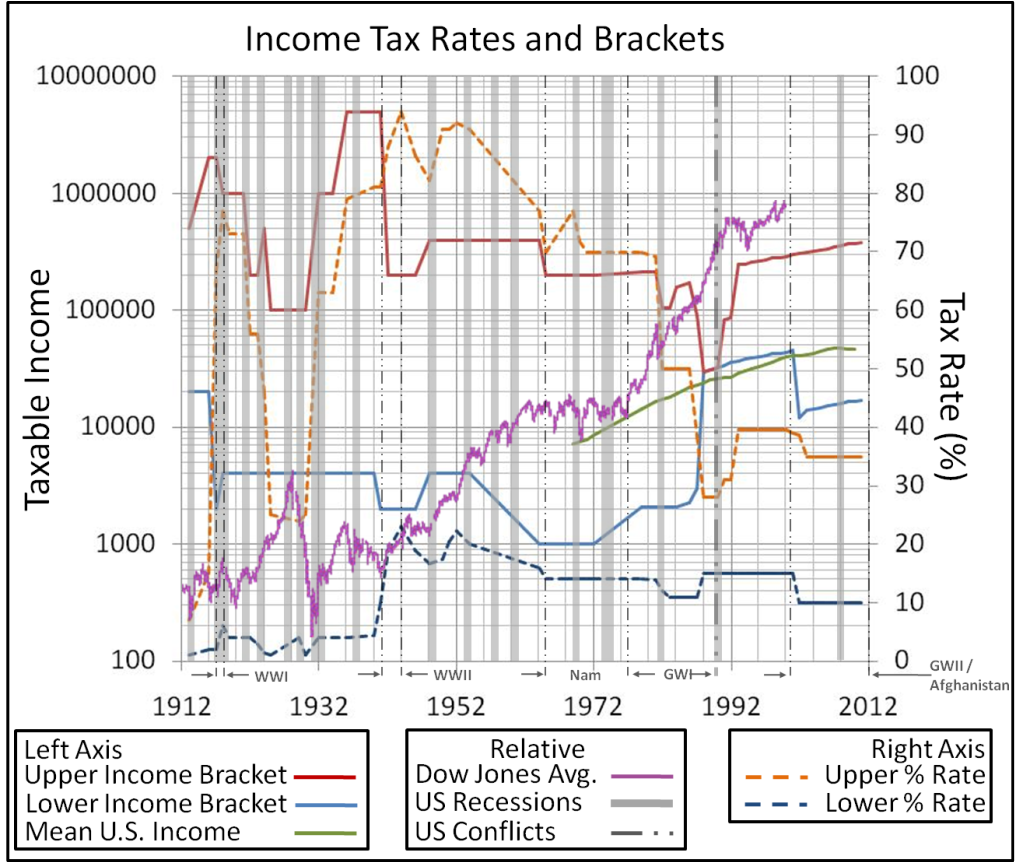
Moving into what I would consider the modern age of government and taxes, starting in 1913 forward to present, this chart shows the upper and lower brackets (left axis), the rate for the brackets (right axis), and for 1969 to present, the mean income (left axis).  Just because it didn't seem complicated enough, I overlaid the DJIA for the period, the recessions of note, and major military actions (time axis only).  There are some interesting possible correlations, but those may only exist in my mind; draw your own conclusions.  Click here for a larger view.


As taxes have evolved throughout the years, from zero early on to a maximum of 94% (for income over $200,000 during World War II), both the rates and the thresholds have changed very frequently.  The current U.S. rates are 15% for the lower bracket and 35% for the upper, which seem reasonable compared to other countries.  In looking at the countries with the ten highest Gross Domestic Products, only Brazil, India, and Canada have higher upper bracket taxes (see chart).  For the lower bracket, which is likely more important since more people are in that bracket and therefore more taxes are collected, only Italy has a higher rate.  Further down the list is Belgium, 21st in GDP according to Wiki and 18th as judged by the IMF, but with a marginal tax rate of 54%; now the U.S. starts to look even better.  In fact, this site indicates that America has the second lowest marginal tax rate.

So it would seem that all-in-all the U.S. fares better than many first-world countries when it comes to taxes.  As much as we would like to complain about this topic, things could be much worse.  Given all of the above, what do the GOP candidates have in store for the future of taxes?

Michele Bachmann believes that taxes are too high (which she should know about, being a tax attorney), people have less to spend on priorities, and that having taxpayers keep more of their earnings would strengthen the economy and stimulate job growth.  She has sponsored several bills in Congress to relieve the tax burden, unfortunately none of them passed.  With typical Republican histrionics, Michele has claimed that “not one shred of evidence that lowering the payroll tax rate created jobs” exists, although BLS data shows more than 1.4 million jobs were created or restored during the 11 months since the tax holiday began.  One of her ideas, for cutting capital gains rates, would seem to add to the deficit rather than help reduce it, but maybe she has other ideas for deficit reduction.  This article is a little inflammatory, but has an intriguing slant, saying that Bachmann’s advice for Americans to flaunt the law borders on treason.  Maybe the most telling words come from fellow party member and Minnesotan, Tim Pawlenty, saying “"Her record of accomplishment in Congress is non-existent.”

“Food stamp president” is what twenty-year political veteran Newt Gingrich called Obama in this article saying, “We’re at the crossroads…down one road is a centralized bureaucratic socialist welfare system…  Down the other road is a proud, solid, reaffirmation of American exceptionalism.”  He too favors the elimination of capital gains tax, and reducing corporate and death taxes; accelerating economic growth by encouraging investment.  His plan is said to be too aggressive and could lead to huge deficits by giving the richest Americans gigantic tax breaks; reducing government revenue by $1.3 trillion in 2015.  Gingrich has plans to keep taxes low, essentially by keeping the “Bush-era” tax cuts, and instituting a flat 15% rate.  Some suggest that a flat tax would cause the loss of more than 800,000 jobs almost immediately, as explained here.

Is the fact that Jon Huntsman served as Obama’s ambassador to China the only reason Republicans won’t support him, or is it because he is a rich, moderate?  He says it’s because, “I don’t sign those silly pledges.  I don’t pander.  I won’t do Don Trump’s silly debate.”  Along with the now common flat tax (although in three rate brackets) and eliminating capital gains tax, Huntsman wants a tax form that, “resembles a postcard”, and to get rid of “all deductions and loopholes.”  He claims that since this worked Utah it can work nation-wide; assuming that this can scale upwards, of course.  Earlier this year he acknowledged that this would constitute a tax increase, saying that he would, “…invest that back into the tax code.”  Here he has a few more words on his tax plan and the economy in general.

Ron Paul goes beyond the Republican pale, planning the complete elimination of income tax and the IRS saying that, “…55%, over half of all revenue, comes from other sources like excise taxes, fees, and corporate taxes…We could eliminate income tax… and still fund the same level of government we had in the late 1990s.”; according to PolitiFact, this is mostly true – a difference of only $150 billion.  He calls income tax “a form of involuntary servitude, which was supposed to have been outlawed by the 13th amendment.”  There is some possible flip-flopping with Paul’s tax plan (called “paulonomics” by some), as shown in this article, which also highlights some of his stances on other issues.

Fox News calls Rick Perry’s tax plan “fiscally irresponsible” and unable to jump start the economy.  According to Fox, the plan calls for taxpayers to choose between a 20% flat tax, and staying with the current system; it seems highly unlikely that most would choose the flat tax.  By his own words, printed in the Wall Street Journal, he says, “The mind-boggling complexity of the current tax code helps large corporations with lawyers and accountants devise the best tax-avoidance strategies money can buy.”, but it seems that little would change in that regard, either.  Perry’s plan also calls for increasing both personal and dependent exemptions, up to $12,500 each, which would seem to lower tax revenue, but according to him, would stimulate economic growth.  This site explains why the tax won’t be as flat as Rick makes it out to be.

Mitt Romney is in favor of tax cuts similar to the ones enacted in 2002 by Bush, claiming that he supported them at the time, and pledges to roll back taxes to 5% by the end of 2012.  In this article he explains how his vision of a “merit-based opportunity society”, compares to Obama’s “European social democracy”, by reducing corporate tax rates and eliminating capital gains, which seems to be very popular among the candidates.  It may be that Mitt feels that his business acumen will give him insight into the workings of the tax codes, which he certainly used to his advantage while working at Bain.  Here are some statements Romney made on taxes and the economy.

Another proponent of lowering taxes, Rick Santorum claims to have always voted in favor of lowering taxes, removing the death tax, and cutting corporate rates.  Know as the “Made in America” plan, it focuses primarily on the manufacturing sector by, in one instance, repatriating off-shore companies and zeroing their tax rate.  Rick plans on making U.S. businesses more competitive by cutting corporate tax rates in half, down to 17.5%.  His personal tax rates, just two brackets, would be 10% and 28%, which is a return to Reagan era rates.

Disregarding corporate taxes, not that they aren’t important to the economy, and also economic stimulus which is equally important, the next most critical aspect of any tax changes, to most Americans, will be the personal income tax rates.  Here is why I think the inequality of income, and of taxes, makes more of a difference than most Republicans give it credit for. 

Let’s look at two groups of American families, one close to average and the other high, upper-middle class.  The average group (Group A) makes between $40,000 and $60,000, and consists of approximately 20,000 families; we will say that their income is $50,000.  The upper group of about 17,000 (Group B) has a lower income level of $100,000 and a top level of $250,000; we will call their income $150,000, on average, for the group.  Using census data, this chart compares expenses for the two groups, with Group B spending 20% more on each expense type (probably not accurate, but I don’t make $150,000, so I’m just guessing).  Now, let’s take, for example, the cost of a home for $150,000; according to this site, it should be a little higher, but this is a good round number.  Group B has, according to the census data and my calculations, almost 5 times the money to spend towards housing, $120,000 per year, while Group A only has $25,000 to spend.  It is clearly much easier for Group B to afford a down payment and mortgage, than for Group A.  This concept extends to any expense that is not considered a need by the census bureau; savings, education, leisure activities like vacations, or emergencies.  While the basic necessity costs are very similar regardless of your income, the amount available for luxuries or niceties is drastically different.

This analysis does not take into account the very rich or the marginally poor, where the differences are even more extreme.  I do not advocate for a socialist system; no sharing of the wealth or redistribution.  One of the few things that can be controlled, to help the lower classes to be able to live just slightly more comfortably, is the amount of tax burden.  Keep this in mind while evaluating each candidate’s plan.

I believe that the first and most important goal of the future president should be reducing waste, fraud, and abuse in all government agencies, followed by examining the efficiency of each federal agency.  Given that the government needs revenue to operate, and if we have learned anything over the years about our government, it is that they rarely cut spending, we will need taxes.  If we believe that the examples we see from other first-world countries are remotely accurate, then U.S. taxes are near reasonable levels.  Assuming that reductions, savings, and gains in efficiency can be made, then we will be better prepared to look at lowering the tax rates.


Wednesday, December 14, 2011

Why I Dislike Our Style of Presidential Debate

Article first published as Why I Dislike Our Style of Presidential Debate on Blogcritics.

We have had, so far, 16 debates during the 2012 presidential race.  I would like to call them, instead of debates, question-and-answer meetings, arguments, character assassinations, popularity contests, pure rhetoric, or in the case of the last question this past Saturday a mutual congratulatory sessions.  None of them have been debates in the classic sense; a single topic with opening statements and rebuttals.  These seem more like political advertisements; considering that most of the candidates have experience with formal debates, this is disturbing.  Maybe this is more the fault of the debate hosts in not structuring them appropriately.


While I appreciate the chance to see the candidates side-by-side, answering the same questions (although sometimes they answer something completely different), I would like to see a more formal debate with specific and limited topics, time constraints, and a more rigid scoring.  As it presently stands, the “slickest” speaker, or the last to speak, frequently is seen as the “winner” of the debate or that particular question.

In the September 22nd debate there was some attempt to limit time, and I like that questions were taken from all over the country, but this high number of questions on a variety of topics make it difficult to assess the candidate’s grasp of the topic.  This was another example of this just being a question-and-answer session – there was no rebuttal.  The first question, on stimulating small business, is a very important issue, but it was only asked of Perry and Romney, and Mitt immediately shifted his answers to some other stump that he wanted to speak on, what I would call wandering afield.

There also seems to be too much time spent describing what is wrong with the current administration, like Bachmann did with her first question, and whether or not you agree with Obama on how he runs the country (such that the president runs anything), the point of these debates is to see how the candidates will address certain issues.  In my opinion, complaining about what is wrong is not constructive. 

The October 18th debate tried to follow some of the rules (limited time and rebuttals), but again had so many questions that all of the candidates could not answer all of the questions.  In the first question, on taxes, it turned into a “what is wrong with Cain’s plan” attack, not an answer to what each candidate would or will do.  While I would have liked a thorough analysis of tax plans, not that Cain’s plan had much of a chance (and now neither does he), there was not enough time spent on this specific topic to understand what each candidate thinks would work, or what they propose.

This is the problem with the candidate’s policy position statements and how they are reported on by the media, by analogy.

____________________________________________________________

Moderator: The first question I would like to ask, concerns all Americans and has been noted as one of the top polling topics during the last week, “Is fruit healthy”?

Candidate A: “I think that the American people like yellow fruit the most, so as president I will ensure that yellow fruit is always available.  My distinguished opponent has insisted that polls show a favor towards red fruit, which is clearly a lie.  My staff has compiled several reports linking red fruit to immoral actions, and I will not stop until red fruit is no longer a threat.”

Candidates B: “Since time immemorial, this great nation has relied on fruit as a part of their daily diet.  Those liberal bastards have claimed that ‘we the people’ are entitled to choose whether to eat fruit or not, and not have fruit thrust upon us.  I say now, that if elected, I will not sleep until this fruit issue is resolved.”

Candidate C: “I have been aware of this fruit issue for years.  I recently signed a pledge stating that fruit is only to be eaten by a man and woman, and I hope that eventually the whole country will sign this pledge as well.  As Governor, I enacted many state laws with regard to fruit, and I believe that as president, I can move those laws into the federal arena.”

Candidate D: “I think that by raising taxes on fruit we will be able to fund further research into fruit as a whole, and eventually resolve this issue.  My opponents think that by lowering taxes, somehow this fruit issue will just go away.  It will never go away while I am in office, of that I can assure you.”

Moderator: “Thank you, sirs and madam, that was very informative and I believe answers that question completely.  Now, moving to the next question…”

____________________________________________________________

All in all, I would rather hear specific plans on how to address each issue from each candidate – if you are not part of the solution, then you are part of the problem.

If you missed any of the debates you can find them all here.

Friday, December 9, 2011

You Would Have to be Crazy or on Drugs to be Homeless

Article first published as You Would Have to be Crazy or on Drugs to be Homeless on Blogcritics.


Although I did not intend for this to be a series, this is the third article I have written about homelessness.  I also wanted to say a few words about mental illness, as I am close to several people so diagnosed.  This came up during commenting (on Blogcritics)on one of the previous articles, and I felt that it needed to be discussed in more detail than the comment structure allows. The previously two articles about homelessness were, “Where Do Americans Live?” and “Ask Not What the Homeless Can Do for You, Ask What TheyCan Do for Themselves.”


This is a much to brief article to allow for more than a thumbnail sketch of mental illness and why homeless people are at a greater risk if they have certain disorders. Nor is it an expose on drugs and street living, but rather a look at how the three come together.  Please use the links provided, and your own searches on the topics, to better educate yourself.

Mental Illness

Most, if not all, people suffer from the effects of mental disorders to some extent.  Perhaps suffer is too strong a word for what many people consider to be personality traits or quirks.  Consider someone you believe to be “anal retentive”; everything has to be just so, or they may be disturbed when their routine is out-of-kilter.  Mostly we adjust to them and their ways, and manage to get along.  But, this could be more than just quirkiness; it might be a manifestation of Obsessive-Compulsive Disorder (OCD).

Another example would be people who seem grumpy or grouchy much of the time, which might be symptomatic of Dysthymia (a mild form of depression) or one of several other mood disorders.  Not liking to speak in public is a fairly common “quirk” but could be seen in people with a mild specific phobia, or other anxiety disorders.

Psychiatrists and Psychologists have diagnostic criteria for all of the disorders and usually some way of scaling or rating them by the effect they have on a person’s life (read more about disorders at PsychCentral).  To be considered as affected by a disorder the symptoms usually have to be continuous for several months, and in some cases up to one year.  This graph shows the incidence of the five major disorder areas in the 12 month, and lifetime prevalence categories used by professionals.  Prevalence is the extent to which the disorder is felt; over a specific time period.

In myself I can see what I call the “edges” of several disorders.  I am slightly OCD; I sometimes feel the need to check to make sure I’ve locked a door, or turned off the water or the stove.  Mostly, I don’t check, but occasionally it nags at me.  Now, imagine that you can’t control the urge to check the stove, or you feel compelled to wash your hands, multiple times, for hours, until they chap and bleed.

I am also slightly autistic, which was much more of a problem when I was younger.  Then, I felt the need to count things; people, tiles or bricks, passing cars.  I seem to have mostly outgrown that but another trait seems to have stayed with me.  When reading, and sometimes during other solitary activities, I rock back and forth, just slightly, or tap my foot, fingers, or shake my leg.  Mostly I don’t even realize that I am doing it, but frequently my wife notices.  This is not something that generally disrupts my life, but I see it as another “edge” of a disorder.  Picture not being able to stop the compulsions, rocking and counting; this is one aspect of full-blown Autism.

This chart lists the most common, of more than 400, mental disorders and their frequency.  Most people with a disorder don’t hear voices or see hallucinations; those types of extreme cases are very rare, occurring in less 1% of the population.  Major depressive disorder, specific phobias, and alcohol abuse top the list, all over 10%.  Other common disorders ranging in frequency from 2% to <10% are: ADHD, PTSD, drug abuse, bipolar disorder, and panic disorder.  Many of these are rare enough that most people never encounter them.

I believe that all humans exist on a continuum consisting of many of these disorders.  The World Health Organization believes that as much as 30% of the world population meets the criteria for a mental disorder at some point in their lives.  If you study the characteristics, or the diagnosis criteria, of say, OCD you will see many of them in people you know, or yourself.  This doesn’t mean that these people need treatment via drugs and counseling; sometimes just the awareness that they have these traits can be enough for them to overcome what many consider to be personality faults.  In the two examples about myself, it is clear, at least to me, that these are very low on the continuum.  

I know of several people, diagnosed with a variety of mental illnesses, some of which I am very close to.  One of them is bipolar, and has had extreme mood swings for over 20 years.  The biggest problem with bipolar disorder is that during the manic phase they are higher than anyone on any recreational drug ever has been.  Although I have never read this in medical publications, I suspect that this feeling is just as addictive, and perhaps more so, than any street drug.  Why would we expect that this addicted person would willingly give up their high?  

But herein lies the rub – the depression that follows these highs are so very low.  Most people have experienced mild depression, from losing a job to a loved one passing, and most people rebound back to a normal emotional level fairly quickly, but imagine being ten or a hundred times that depressed.  The bipolar sufferers MUST be on the medication at all times to prevent going into a, perhaps fatal, depression.  If left to their own devices the manic personality will demand that high with no thoughts to the resultant consequences.  Many of them then self-medicate to try and alleviate the depression – usually with street drugs or alcohol.  Either of these will add their own set of problems that do not mesh well with their ailment.  This article, “Self-medicating: Whenthe Cure IS the Disease”, has some more information about co-morbidity and dual-diagnoses.

Having two or more disorders is known as co-morbidity and occurs very frequently with some disorders.  Perhaps the greatest co-morbid disorders are substance abuse, and either anxiety or mood disorders, being twice as likely as in those not using drugs.  There are four risk factors associated with this co-morbidity: genetic vulnerabilities; environmental triggers; developmental effects; and the fact that similar areas of the brain are involved.  A recently recognized co-morbid connection was found between substance disorders, perhaps not surprisingly, and Post-Traumatic Stress Disorder (PTSD).  In one recent study 23% of over 9,200 patients were found to have three, co-morbid diagnoses.

Another person that I know has a panoply of diagnoses: Antisocial personality disorder, which causes them to completely disregard the feelings of others; Borderline personality disorder, similar to bipolar in that they have mood swings but more importantly is the unstable sense of identity and difficulty with interpersonal relationships; Narcissistic personality disorder, prompting unrealistic fantasies, requiring constant attention, lacking empathy; Panic disorder; and in my opinion Schizophrenia because of the observed paranoia, social withdrawal, and drug use (as many  as 50% of Schizophrenics abuse drugs).  These are some very troubling diagnoses and also very hard to live with, but mostly manageable with the proper use of medications and therapy.

At this time, neither of them is homeless, but the situation for them, and for others suffering from many types of mental disorders, could change at any time.

Substance Abuse

Although substance abuse is considered to be a mental disorder, I think it deserves a few words.  This is an epidemic in almost every sense of the word:

  • Increased virulence – the purity and availability of many drugs have increased dramatically
  • Introduction into novel settings – meth has moved into small towns throughout the U.S.
  • Changes in host exposure and susceptibility – younger children are being exposed to drugs every year.

Don’t you think that more than 20 million user’s, or over 6% of the U.S. population constitutes an epidemic?

I’m not sure if I understand why one of the only areas in which the U.S continues to lead the world is in illegal drug use.

But, enough on drugs for now; I have a future article in the works on that.

Homelessness

There are two commonly used definitions for homelessness: “Not having customary access to a conventional dwelling” and “living in public or private emergency shelters; or in the streets, parks, subways, bus terminals, rail stations, airports, under bridges or aqueducts, abandoned buildings, cars, or in any public or private space not designated for shelters.”  Neither of these definitions addresses every possible situation, nor can they be expected to encompass every one, in just a few words.  But regardless of the official definition, we know homelessness when we see it.

The total number of homeless is nearly impossible to estimate, since there is no place where they are known to be, at any given time.  Several different counts have arrived at around 1, 500,000 people as of 2011.  The map on this blog shows the national distribution, with most populous states and cities having the most homeless.

I mentioned in my previous article that a major concern that had come to the attention of the United Nations was a lack of clean, safe water.  This, and the lack of proper sanitation facilities are adding a third factor to the overall problem; traditional diseases.

The single greatest cause for homelessness is lack of affordable housing, whether it is from foreclosure, loss of public assistance, or because some other need is more pressing than the rent.  The most common composition of homeless families is a mother with one to two children.  It shouldn’t be surprising that in this situation, food or medical care for the children is more important than housing.  One in fifty children in the U.S. will experience homelessness in their lifetime; and they will be twice as likely to go hungry, or have health problems as adults, and have less than a 25% chance of finishing high school.

In most cities there are shelters which can provide, at least temporary, accommodations, but these are neither permanent nor do they provide any sort of medical or therapeutic treatment.  There are programs, such as the Homeless Outreach Project, in New York and other cities, which have helped a significant number of the homeless living in city parks into treatment, entitlement programs, and temporary housing.  The greatest limiting factor is still permanent housing, but below are links to the outreach project websites for San Diego, Los Angeles, Denver, Kansas City, Chicago, Philadelphia, New York, and Miami.  There isn’t room here for an exhaustive list, but if you want to help there are places that need it.

Mixing the Three


One question to consider is whether a homeless person is more likely to have a mental disorder, or substance abuse problem, before or after becoming homeless.  Not surprising, to me at any rate, is that there is no clear understanding of this question; it is almost classically, a chicken-and-egg problem.  Unquestionably though, if people like these are living on the street, without even basic medical treatment, especially those with a high probability of co-morbid diagnoses, without the specialized drugs and counseling usually needed, how can they be expected to even cope, much less improve.

Another disturbing aspect in this whole situation is the appalling number of veterans that are among the homeless.  One estimate shows that more than 10% of the total number was in the military, down from as much as 30% in 2004.  Back to the chicken/egg, are they homeless because of PTSD, or does the homelessness exacerbate the PTSD?  Use these links for more on veterans and PTSD.

One of the most significant issues with getting help for the homeless that are also mentally ill and/or substance abusers is facilities that that can handle the complex interconnected problems.  A run-of-the-mill shelter is not set up to give treatment or therapy for either case.  Drug rehabilitation clinics usually don’t have psychiatrists or psychologists trained in mental health issues.  What is needed is a facility that does have all necessary people and equipment in one place.

Problem or Solution

I had said in my second article on this topic that one solution to the homeless problem would be to house them in their own “village” with necessities supplied, such as: housing, food, education, training, and most importantly, medical care.  The long term goal of this program would be helping to reestablish them into normal society.  Furthermore, I suggested that if deemed appropriate, this newly trained group could, repay if you will, by working on state or federal-level infrastructure projects, ala President Roosevelt’s CCC or WPA programs.  Those were effective not only in allowing millions of unemployed to work and earn pay, but also provided dams, highways, national parks, and other large-scale projects.

One of the reasons that I thought my plan had merit was because it allows maximum resource utilization.  We do this all of the time; a team is dispatched to tackle a fire, not a lone fireman.  Likewise, we collocate certain facilities as in hospitals; doctors, pharmacy, radiology, and surgery.  I propose the same sort of thing:  for housing it’s like a hotel with all needed services in one place; for food, it’s like a restaurant with storage, refrigerators, stoves, cooks all in one place; with training, as in a school, with instructors and training materials all together; and exactly like in a hospital, for medical needs.  How can it not make sense to do these things all in one location, instead of spread out in several locations, with volunteers trying to get back and forth, without all of the things you need to make it work, not at hand?

There were, and of course will be, detractors to this plan, saying that this would be just another ghetto, or that it sounded like a Dickensian work-house.  Certainly, if care is not taken and a multi-year or even multi-decade plan is not established, including funding, then it could turn out that way.  Any program is only as good as the people working on it, intentions notwithstanding; we know where good intentions lead.

I just don’t think this is possible on a small scale, which is what is happening now.  Volunteer organizations, church groups, scout troops, compassionate individuals are all trying to help, but in many cases it is just too little.  As I said above, this needs to have resources, which are too expensive and too spread out, which are organized in the most efficient way possible.

I don’t see how we can consider these people crazy; we are the one that have the means to fix this – and we don’t.


Saturday, December 3, 2011

Ask Not What The Homeless Can Do For You, Ask What They Can Do For Themselves

Article first published as Ask Not What the Homeless Can Do for You, Ask What They Can Do for Themselves on Blogcritics.

In an earlier article I wrote briefly about homelessness, and stated that a primary cause was mental illness, followed by substance abuse.  I would like to clarify and elaborate on that, give some cites (and sites) for more information, and posit a possible solution.

I started my recent reading using the Wikipedia Article on homelessness in the US.  [Note on Wiki articles – Some of you don’t trust Wiki articles and you are right to be suspicious, but there is frequently good information to be found there.  I have been using it for basic research for many years and found that it is mostly reliable.  The best articles will be lengthy and detailed, have extensive references, and plenty of external links.  At the least, it is a good place to start for a basic understanding of a topic.]  I followed several of the internal and external links to find more information, and also checked many of the references to satisfy myself that the information presented was good.  I think that it is, but Caveat Emptor.

The actual numbers of homeless are hard to quantify, since there is no national effort to do so, only the collation of local and/or state reports.  Most large cities have a fair estimate of those using shelters, but the numbers for those not using government or charity shelters is at best a guess, and as for small towns and rural areas, it is worse than a guess.  Lest you think that Congress is not in this loop, here is the annual report to them for 2011.

This article about criminalizing homelessness and the source of the statement that the UN was concerned about safe drinking water in our homeless population.  I have wondered in the past why so much advertising money is spent on charities to provide food, water, and shelter for foreign children (“Please help. For only $0.23 per day you can…”), when we have adults AND children in our own country that have those same needs.  The cynic in me believes that most charities are scams to provide money to the organizers, but realistically, I know that SOME of them probably do some good.  As Thomas Fuller said, “Charity begins at home, but should not end there.”

The Prime cause for homelessness is said to be a lack of affordable housing, and I can’t argue against that.  But as I recall, in almost every large city, there are what we call “projects” that were supposed to be low-cost housing.  I also recall that these have become breeding grounds for drugs, gangs, violence, and crime.  It shows up in the news like in this story, or this one.   I don’t know why this doesn't work like we expect, but it may have more to do with racial or ethnic segregation and discrimination than we would like, as described in this paper.

We can trace the genesis of the mentally-ill homeless to the late 1960s and early 1970s when there was a movement towards deinstitutionalization.  The idea had lofty goals; to move mentally ill people from large, impersonal institutions into a more community-centric care system.  Unfortunately, and to our shame, this did not work as planned, and I hope that this was not done at the behest of a rich cabal solely to make more money.  This article  has both a good description of the problem and some references.  For those of you that want to understand the numbers better, here is a paper using 29 different studies.  This
PBS site has a good list of the statistics and some links to other good information.

There is some question as to whether homeless people are more likely to become mentally ill while living on the streets, or that mentally ill people are more likely to have no other place to live.  I don’t see that being homeless is causative; it seems more likely that homelessness makes their illness worse, if only because they lack access to medical treatment and counseling.  It would seem more likely that this is true of substance abuse than of mental illness.

Here is an article that discusses the problem in our friendly neighbors to the north, Canada.  I have run across several studies that were performed in Western Europe, so we know that the problem is not isolated to America, or even the North American continent.  I’m not going to cite those since I am most concerned in the immediate US problem (and this is getting kind of long).

There is also a high incidence of co-morbidity with mental illness and substance abuse, probably stemming from the prevalence of using drugs to self-medicate.  It is much more difficult to treat a mental illness when drug abuse is present.  Here is an article describing this dual diagnosis from the National Alliance on Mental Illness.  There have been some studies looking into all three of these co-linked problems: Housing, Mental illness, and Substance abuse.  This article talks about all three.

We don’t want to forget that a large portion of the homeless are veterans, to whom we owe a large debt.  They, being a subset of the overall population of the US, have similar ratios of substance abuse and are more likely to have a mental illness with the additional possibility of PTSD.

On my personal blog I wrote an article about how we might provide some jobs to the unemployed.  One of my solutions was to copy, as much as feasible, the CCC and WPA programs from the 1930s and 1940s – this was the same “New Deal” that is currently being disparagingly talked about in Washington.   These programs spent a large amount of government money, but also provided work for those that needed it and built up some national infrastructure.  It looks to me like we could stand to do both of those things again, now.

So, here is my basic plan – we build small, self-sufficient villages for these people, as near major population centers as reasonable.  The homeless will help construct and maintain these small towns, each contributing as their ability and health permits.  Overseeing these projects are the thousands of returning military service-people, many of which will need facilities such as are being built for themselves.  For those requiring it, medication can be supplied, or in the case of abuse their recovery and rehabilitation can be monitored.  In both of these cases this would be an absolute requirement for living and working in this place.  It may turn out that some of the severely mentally ill people can never significantly contribute to society, and if that is the case, they will have a pleasant location to live out their lives in safe surroundings.

As skills and abilities are acquired or enhanced, these newly enabled people can move back into the general population.  This would seem to satisfy the basic need of housing, the secondary need of work and building self-esteem, and a tertiary need of gaining education and skills to be able to re-enter the workforce.  The concentration of efforts should allow for maximum efficiency in distribution of funds to start and maintain these facilities.

I don’t have any estimates on what this program might cost, but whatever that is; doesn’t it seem like a good investment?  If this basic idea works, then it seems possible to expand it to the original goals of the CCC and WPA; having the newly skilled work force apply themselves to infrastructure projects.  Construction and maintenance of the levee system looks like a good place to start.

I’m sure that there are people out there that have a better understanding than I do of what needs to be done, so please speak up.  I would think that it is possible to get, even the ultra-conservatives behind this.  We sell it as “making the streets safer”, or “making the city more attractive”, or something similar.  Advertising agencies could be hired to make it sound compelling to the rich.

What do you think?

Thursday, December 1, 2011

Where do Americans Live?


Article first published as Where do Americans Live? on Blogcritics.

Our country is big, almost 4 million square miles, and at that size, the third largest in the world.  This land is both mine and yours, from California (or Hawaii) to the New York islands, from the redwood forests to the Gulf Stream waters, the song says it all.  We have, according to another song, amber waves of grain, purple mountain majesties, and fruited plains.

It seems like enough space, and plentiful bounty, for our 300 million citizens and more.  Some of these citizens live in mansions while others live under bridges, but most live rather modestly, comfortably even.  By far, most of these people deserve to live here, having that right by birth and many of the rest are working on it through naturalization – then they too will have that right.

But the RIGHT to live within these United States does not automatically confer a PLACE to live.  Some estimates for 2011 state that there are 1.5 million homeless people; around 41% of them families with children.  The reasons range from lack of affordable housing, unemployment, or poverty to mental illness, substance abuse, or domestic violence.  But regardless of the reason, don’t these humans – fellow Americans – deserve a place to live?  Many of these people are, according the U.N. Universal Declaration of Human Rights, lacking in basic human rights such as safe drinking water.

Some recent studies have suggested that as much as 30% of the homeless suffer from mental illness, and although it is hard to estimate the exact number, it is suspected that a high percentage of these ailing people also abuse some substance; it is not clear if the substance abuse is causative in their homelessness.  At any one time, more than 100,000 of these homeless people are military veterans, on the streets for many of the same reasons as non-vets, but with the additional complication of Post-Traumatic Stress Disorder.  Don’t we owe these vets, who risked their lives so that you could sleep safe in your home, at the very least, a place to live?  In fact, don’t all of these people, be they sick or poor, deserve that same comfort that so many of us take for granted?

Although it is popular to vilify the rich for the problems of the poor, in the case of homelessness it is much closer to the truth, than not.  One of the primary reasons for homelessness is lack of homes.  As cities grow they frequently overrun the areas where low-income families live; razing their homes to replace them with upscale houses, condominiums, or McMansions.  This is not just an American phenomenon, but exists wherever there are large cities.  In America we call them slums and in Brazil they are known as Favelas.  Note in the two pictures the similarities.  Do we want for all of our cities to look like this?


Wouldn’t we like to be known as the generation in which homelessness was a thing of the past?

Monday, November 21, 2011

Can we do anything to improve the job and economy situation?


I made some comments in several forums today that got me to thinking about how to get unemployed people back to work.  If we can get the unemployment rate down, I believe that the economy will improve; investors will have more confidence, buyers will spend more, people will be able to buy houses, and the republicans will get richer (really, no matter what happens to the economy, they will get richer).

The main problem I see with unemployment is that as an entitlement program it gives away money, but there is no other gain from it.  By this I mean that the person receiving it does not gain any new tangible knowledge, skills, or abilities.  All of the entitlement programs should be restructured so that the person benefits in some other way than just receiving a pay check.  Additionally, if the country could benefit in some way while disbursing the money, we would all be better off.

In the 1930s FDR started several programs to ease the US out of the great depression, including the Civilian Conservation Corps (CCC) and the Works Progress Administration (WPA later re-designated as Works Projects Admin).  Both of these programs used unemployed, unskilled labor to improve the infrastructure of the country.

The CCC was primarily responsible for the conservation and development of natural resources, which included such things as: bridges, fire towers, and buildings in national forest areas; irrigation, drainage, dams, and other flood control measures; planting trees, collecting seeds, working in nurseries, and related forestry work, building and maintaining camps and picnic areas, clearing areas, developing and maintaining lakes and ponds; and miscellaneous work such as surveying, large scale mosquito control, and emergency relief.  As many as 2.5 million men took advantage of this program over about nine years.  The WPA made use of another roughly 3 million people over some 8 years on basic infrastructure improvements such as roads, bridges, parks, and dams.  Altogether these two programs employed more than 5 million people that would otherwise been on what we would today call welfare.  That 5 M people represented approximately 4.5% of the 1935 US population.  In 2011 the total unemployed number is around 13 million or about 4.4% of the population.  If we ran similar, proportionally sized projects now, we could give jobs to all of the unemployed and satisfy important national needs.

The question becomes: what projects should we tackle? 

One possibility, right out of the 1930s, that would surely help both the newly employed and others, is dam and levee construction and/or maintenance.  All along the Mississippi river and its feeder rivers are miles of damaged or broken levees.  We have seen in the last few years what the failure of these river control measures can mean to those who live in the flood paths.  Homes and farms destroyed, cities ravaged by the water, and lives lost when the levees break.

Another suggestion is repair of the 50+ year old interstate highway system.

A third is fire prevention in the national forests by clearing brush, creating new fire roads, even reforestation of recently burned areas.

I slightly over 20 minutes I have come up with three possible uses for millions of unemployed people.  How many other possibilities are there?

This kind of work would seem to be a much more valuable stimulus both to the individuals and to the country, than just giving people money and saying “keep looking for work”.

I leave you with a few quotes by FDR – a man and president that lived through the worst times that our country has ever seen, and brought us out of it.

--“A nation that destroys its soils destroys itself. Forests are the lungs of our land, purifying the air and giving fresh strength to our people.”

--“The test of our progress is not whether we add more to the abundance of those who have much; it is whether we provide enough for those who have too little.”

--“Happiness is not in the mere possession of money; it lies in the joy of achievement, in the thrill of creative effort.”

--“True individual freedom cannot exist without economic security and independence. People who are hungry and out of a job are the stuff of which dictatorships are made.

--“There is nothing so American as our national parks. The scenery and the wildlife are native. The fundamental idea behind the parks is native. It is, in brief, that the country belongs to the people, that it is in process of making for the enrichment of the lives of all of us. The parks stand as the outward symbol of the great human principle.”

--“To the Congress:

Unhappy events abroad have re-taught us two simple truths about the liberty of a democratic people.

The first truth is that the liberty of a democracy is not safe if the people tolerate the growth of private power to a point where it becomes stronger than their democratic state itself. That, in its essence, is Fascism—ownership of Government by an individual, by a group, or by any other controlling private power.

The second truth is that the liberty of a democracy is not safe if its business system does not provide employment and produce and distribute goods in such a way as to sustain an acceptable standard of living.

Both lessons hit home.

Among us today a concentration of private power without equal in history is growing.

This concentration is seriously impairing the economic effectiveness of private enterprise as a way of providing employment for labor and capital and as a way of assuring a more equitable distribution of income and earnings among the people of the nation as a whole.”